

Homebuyer meeting with mortgage advisor about bad credit home loan
Can You Get a Home Loan with Bad Credit

Getting approved for a home loan with damaged credit? It happens every day—though you'll face steeper costs and fewer lenders willing to work with you. Government-backed mortgage programs keep homeownership within reach for borrowers sitting in the 500–620 credit range, even when traditional banks turn them down. The challenge isn't finding a "yes," it's figuring out which financing route makes sense for your wallet and how much extra you'll pay for that approval.
About 16% of U.S. consumers carry credit scores under 580. Despite that damaged credit, thousands of these borrowers close on homes each year. What separates approved buyers from rejected ones? They understand which programs overlook low scores, what other financial strengths can compensate for credit damage, and how to avoid mistakes that sink otherwise solid applications.
Understanding How Bad Credit Affects Your Home Loan Eligibility
The credit scoring system runs from 300 at the bottom to 850 at the top. Here's how most mortgage lenders categorize borrowers: anything under 580 gets labeled "poor," the 580–619 range falls into "fair" territory, and 620–679 lands you in "average" status. When mortgage professionals talk about "bad credit," they're usually referring to scores sitting below 620—though you'll find some lenders who use 600 or 640 as their cutoff line depending on their risk appetite.
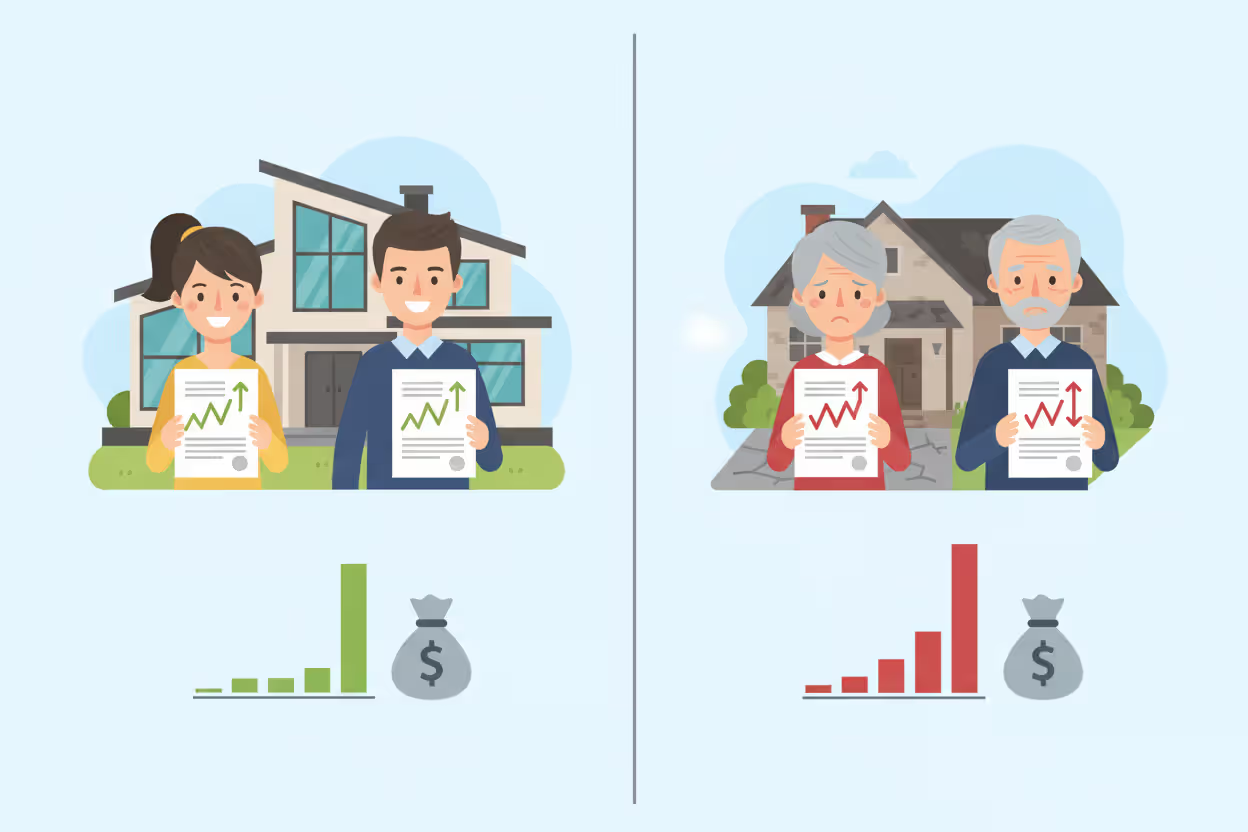
How bad credit affects home financing shows up first in your interest rate. Someone applying with a 620 score typically gets quoted rates running 1.5 to 2 full percentage points higher than an applicant with a 740 score. Picture a $300,000 loan over thirty years—that rate gap translates to roughly $90,000 in additional interest you'll pay. Lenders aren't being punitive; they're pricing in default risk based on decades of data showing lower scores correlate with higher foreclosure rates.
Author: Ethan Callahan;
Source: isomfence.com
Your down payment demands go up alongside those rates. A borrower with a 720 score might slide by with just 3% down on certain conventional mortgages. Drop to a 580 score? Now you're looking at 10% or more as a minimum, unless you qualify for specific government programs with lower thresholds. Lenders want to see you've got significant money invested—it makes walking away from the property less appealing if financial trouble hits.
Getting to "yes" becomes harder as your score drops. Qualifying for a home loan with poor credit means your other financial metrics need to shine. A 590 score paired with a 50% debt-to-income ratio and a resume showing job changes every eighteen months? That's headed for rejection. Take that same 590 score but add a 30% DTI, five consecutive years with one employer, and six months of mortgage payments sitting in savings? You've just moved into approval territory.
Mortgage insurance becomes non-negotiable when you're putting less than 20% down, tacking on $150–$300 monthly to a $300,000 loan. This coverage protects the lender if you stop paying—it does nothing for you—and stays attached to most loans until you've built up 20% equity through monthly payments or property appreciation.
Not every lender accepts applications from borrowers under 600. Some won't touch you at any score below that threshold regardless of your other qualifications. Others have built entire businesses around subprime lending, though they'll charge premium rates for taking on that risk. The lending landscape varies wildly by institution and loan product.
Home Loan Programs That Accept Bad Credit Borrowers
Four main programs dominate home loan options with bad credit, each bringing different minimum requirements and cost structures.
FHA Loans
The Federal Housing Administration insures mortgages that go as low as 500 on the credit spectrum—but you'll need 10% for your down payment at that level. Hit 580 and you can drop that down payment requirement to just 3.5%. These government-backed mortgages exist because FHA insurance protects lenders from losses when defaults happen, making them willing to approve riskier borrowers.
You'll pay for that protection twice: an upfront mortgage insurance premium of 1.75% of your loan amount (typically rolled into your mortgage balance) plus annual premiums ranging from 0.55% to 0.85% depending on your loan size and down payment. Finance $280,000 and you're looking at $4,900 added to your loan upfront, plus about $170 every month for as long as you keep that loan unless you refinance out of it.
FHA underwriting pushes debt-to-income ratios as high as 50% in certain situations—significantly more flexible than conventional financing. You'll need employment or income documentation covering the past two years, though switching jobs within your same industry won't automatically disqualify you. Bankruptcies need to be at least two years behind you; foreclosures require three years of seasoning.
First-time buyers with minimal savings get the most value from FHA loans. That 3.5% down payment option opens the door much sooner than conventional financing, even though you'll carry that permanent mortgage insurance as an ongoing cost.
VA Loans
The Department of Veterans Affairs doesn't set a minimum credit score requirement in its official guidelines, but individual lenders typically want to see at least 580–620 before they'll approve your application. These loans eliminate down payment requirements entirely and don't require mortgage insurance, making them the strongest available option for qualifying veterans, active-duty service members, and certain surviving spouses.
VA underwriting accepts debt-to-income ratios pushing 50%–60% when you've got strong compensating factors working in your favor. The VA funding fee (ranging from 1.4% to 3.6% based on your down payment amount and whether this is your first VA loan) takes the place of traditional mortgage insurance but costs substantially less over time. Veterans with service-connected disabilities pay zero funding fee.
Your credit evaluation focuses heavily on the past twelve months of payment history rather than just your three-digit score. You'll need two years of distance from bankruptcy and two years from foreclosure. Recent late payments on housing expenses or utilities carry more weight than old collection accounts, assuming you've demonstrated financial responsibility lately.
Veterans dealing with credit damage but maintaining steady income and limited savings benefit most from this program. The zero-down structure removes the biggest obstacle preventing homeownership, though you'll still need cash available for closing costs—typically 2%–5% of your purchase price unless you negotiate seller concessions to cover them.
USDA Loans
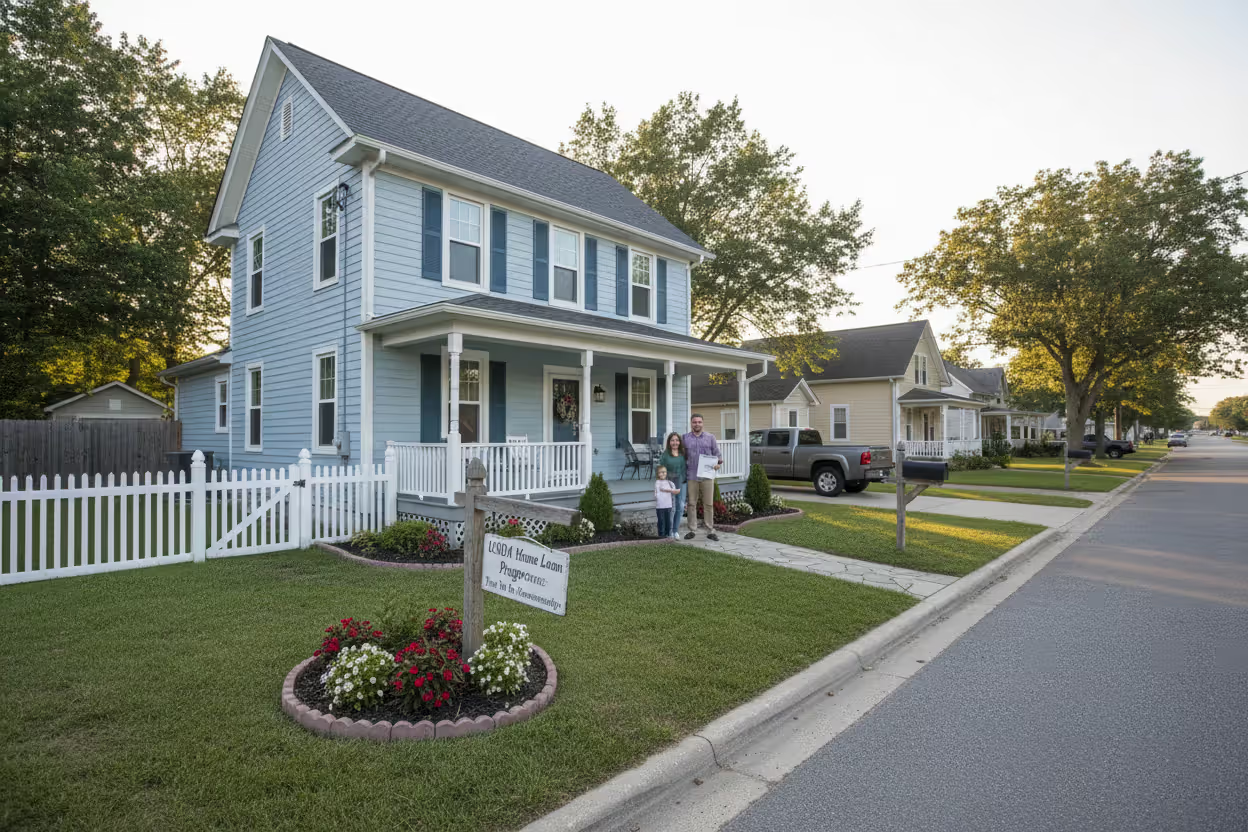
The Department of Agriculture finances homes in rural and suburban locations—a much broader definition than most people realize, covering approximately 97% of U.S. land area and including towns with populations reaching 35,000. These mortgages require no down payment and accept credit scores as low as 580 through automated underwriting systems, sometimes lower if underwriters manually review your file.
Borrowers pay an upfront guarantee fee equal to 1% of the loan amount plus an annual fee of 0.35%—both figures coming in below FHA's insurance costs. You'll face income restrictions: your household earnings can't exceed 115% of the median income for your area, which varies based on where you're buying and how many people live with you.
Debt-to-income calculations max out around 41% on the front-end ratio (just housing costs) and 46% on the back-end (all monthly debts combined), though underwriters do make exceptions. You'll need documented income history and credit patterns over the past year showing acceptable payment behavior.
Rural buyers dealing with credit damage and moderate income levels who lack down payment savings find the most value here. Geographic eligibility represents the primary limitation—verify the property qualifies before you invest time and emotion into a specific house.
Author: Ethan Callahan;
Source: isomfence.com
Conventional Loans with Compensating Factors
Traditional conventional mortgages typically draw their line at 620 for minimum credit scores, but certain portfolio lenders will dip to 580 when you bring significant compensating factors: down payments exceeding 20%, debt-to-income ratios under 35%, substantial cash reserves covering six months or more of payments, or documented income growth showing clear upward trajectory.
Private mortgage insurance on conventional products can be dropped once you've built 20% equity—unlike FHA's permanent insurance that stays for the life of the loan. Your rates and terms improve noticeably at 640, then again at 660, so even modest score improvements create measurable savings.
Conventional financing works best for credit-damaged borrowers sitting on substantial savings who can put down 25% or more. Show that kind of down payment alongside strong income documentation, and you'll find lenders willing to overlook a 600 score.
| Loan Program | Credit Score Minimum | Required Down Payment | Insurance Costs | Best Suited For |
| FHA | 580 for 3.5% down; 500 for 10% down | 3.5% standard; 10% if score under 580 | Upfront premium of 1.75% plus annual 0.55%–0.85% that never drops off | First-time purchasers with minimal savings, steady employment, scores between 580–640 |
| VA | No published minimum; lenders want 580–620 | None required | No monthly insurance; one-time funding fee of 1.4%–3.6% | Veterans and active military with credit damage, little saved for down payment, reliable income |
| USDA | 580 for automated approval; lower with manual underwriting | None required | Upfront fee of 1% plus annual 0.35% | Rural/suburban purchasers with moderate earnings, damaged credit, no down payment funds |
| Conventional | 620 typical; 580 possible with offsetting strengths | 3%–20%+ based on score and other factors | Required below 20% down; removable after reaching 20% equity | Applicants at 620+ or those with substantial down payments to balance out lower scores |
What Lenders Look at Beyond Your Credit Score
Qualifying for a home loan with poor credit demands excellence in other areas of your financial profile. Lenders rely on compensating factors to offset risk when scores don't meet their comfort level.
Your debt-to-income ratio compares monthly debt obligations against gross monthly income. Conventional lenders typically want this figure under 43%, while FHA and VA programs stretch to 50% or higher. Picture someone earning $6,000 monthly with $1,800 in recurring debts—car payment, student loans, credit cards, plus the proposed mortgage payment. That's a 30% DTI sitting comfortably within approval range. Increase those debts to $2,800 and you're at 47% DTI, which now requires stronger credit scores or additional compensating factors.
You'll calculate DTI by totaling every minimum monthly debt payment (including your projected mortgage with property taxes and homeowners insurance) then dividing by gross monthly income before taxes. Don't include utility bills, groceries, gas, or other variable monthly expenses.
Employment history carries more weight than many borrowers realize. Two consecutive years with the same employer—or within the same industry—demonstrates stability lenders value. Frequent job transitions raise questions even when income stays strong, particularly if you're between positions during your application. Self-employed applicants need tax returns covering two years showing income that's consistent or trending upward.
Down payment size directly reduces the lender's exposure. Someone investing 20% down has substantially more to lose if they walk away, plus the lender maintains a larger equity cushion if foreclosure becomes necessary. Boosting your down payment from 5% to 15% can offset a 30-point credit score deficit in certain underwriting models.
Cash reserves prove you can weather unexpected financial disruptions. Six months of mortgage payments sitting in savings demonstrates you won't immediately default after a job loss. Reserves become increasingly important for investment properties and applications with elevated debt-to-income ratios.
Recent credit behavior outweighs historical problems in many underwriters' eyes. A borrower carrying a 580 score from medical collections three years ago who's made every payment on time since presents better than a 620 score with three late payments within the past year. Lenders want evidence of positive momentum.
Rent payment history can compensate for thin credit files. Twelve months of bank statements or canceled checks proving on-time rent payments demonstrates your housing payment reliability even when traditional credit remains weak.

Author: Ethan Callahan;
Source: isomfence.com
Steps to Improve Your Approval Odds with Bad Credit
Improving approval odds with bad credit takes strategic moves starting months before you apply.
Attack revolving debt with focused intensity. Credit utilization—the percentage of your available credit you're actually using—drives 30% of your FICO score calculation. Dropping from 80% utilization down to 30% can spike your score 40–60 points within eight weeks. Eliminate small balances completely rather than spreading minimum payments across multiple cards.
Challenge credit report errors the moment you spot them. Research shows one in five credit reports contains mistakes that could derail approval. Pull your reports from Experian, Equifax, and TransUnion through AnnualCreditReport.com, then dispute anything incorrect: accounts you never opened, late payments you actually made on time, wrong balance amounts, or negative items that should've been removed years ago.
Build your down payment fund while simultaneously repairing credit. Each additional percentage point you put down shrinks the lender's risk and might unlock better rates or program options. Set up automatic transfers into a separate savings account so you won't be tempted to redirect that money.
Seek pre-qualification from multiple lenders to understand your real positioning. Pre-qualification uses soft credit inquiries that don't impact your score and provides realistic expectations about available rates and required down payments. When you're ready for formal applications, shop within a 45-day window—multiple mortgage inquiries clustered in this timeframe count as just one hard pull.
Explore co-signer or co-borrower options with someone carrying stronger credit. Their score and income strengthen your application, though they become equally liable for the debt. This strategy works best with family members who trust your ability to make payments and fully understand the risk they're accepting.
Freeze new credit applications for six months leading up to your mortgage application. Every hard inquiry temporarily drops scores 5–10 points, and multiple recent inquiries signal financial distress to underwriters reviewing your file.
Draft a detailed explanation letter addressing past credit problems. If bankruptcy, foreclosure, overwhelming medical bills, or other circumstances destroyed your credit, a clear letter explaining what happened and documenting your recovery helps underwriters see beyond the numbers. Attach supporting documentation like medical bills, divorce decrees, or layoff notices when relevant.
Consider strategic waiting if you're near a threshold. A borrower sitting at 575 might qualify for FHA with 10% down now, but waiting four months to hit 580 unlocks 3.5% down. Calculate whether waiting saves more than you'd spend continuing to rent.
Common Mistakes That Hurt Bad Credit Home Loan Applications
Following a bad credit home borrowing guide means sidestepping common pitfalls that destroy otherwise approvable applications.
Scattering applications across months damages scores unnecessarily. Multiple mortgage inquiries compressed within 45 days count as a single inquiry for scoring purposes, but spreading applications over twelve weeks creates multiple scoring hits. Select three to five lenders, submit applications within a tight timeframe, then compare your offers.
Financing major purchases between approval and closing wrecks debt-to-income ratios and triggers red flags. Taking out car loans, furniture financing, or appliance credit between your approval and closing date can push DTI over acceptable limits and trigger outright loan denial. Lenders re-verify credit days before closing—they'll catch new debt.
Switching jobs mid-application complicates approval even when you're earning more money. Lenders verify employment right before you close. Starting a new position, even within your same field, might require waiting for several paystubs or completely restarting underwriting. Talk to your loan officer immediately if a job change becomes unavoidable.
Overlooking credit report mistakes sacrifices points and approval chances. Disputing errors takes a minimum of 30 days for resolution, so start months before applying. Don't dismiss small errors as irrelevant—a $50 collection you already paid that still shows as an open account can trigger automated underwriting denials.
Exhausting savings for your down payment without maintaining reserves can lead to rejection. Certain programs mandate post-closing reserves. Even when not explicitly required, showing zero savings after closing makes underwriters nervous about your ability to handle unexpected expenses.
Skipping the rate shopping process costs thousands in unnecessary expenses. Rate and fee variations between lenders prove substantial, especially for damaged credit borrowers. One lender might quote 7.5% while another offers 6.8% for identical credit profiles. Obtain Loan Estimates from multiple sources and compare total costs, not just the advertised rates.
Applying for mismatched loan programs wastes everyone's time. A rural veteran pursuing FHA instead of VA leaves significant money on the table. A suburban buyer trying conventional financing with a 590 score faces likely rejection when FHA would approve them. Match your profile to the appropriate program from day one.

Author: Ethan Callahan;
Source: isomfence.com
Costs and Trade-offs of Borrowing with Poor Credit
How bad credit affects home financing becomes most visible in long-term costs. A borrower with a 620 score might receive a 6.5% interest rate quote while a 760 score gets offered 5.0% on an identical $300,000 loan. The 620 borrower pays $1,896 monthly versus $1,610 for the 760 borrower—$286 every month adding up to $102,960 over three decades.
Private mortgage insurance stacks another cost layer on top. Put down less than 20% with a score under 680, and you're looking at PMI between 0.5%–1.5% of your loan amount annually. On a $285,000 loan (5% down on a $300,000 purchase), that works out to $1,425–$4,275 yearly or $119–$356 monthly. FHA's permanent insurance structure means paying this for the entire loan duration unless you refinance later.
Larger down payments reduce monthly expenses but delay your purchase timeline. A borrower saving for 10% down rather than 3.5% on a $300,000 house needs an additional $19,500—approximately 18 months of saving $1,100 each month. During those months, home prices in your market might appreciate 3%–5% annually, potentially erasing any savings the larger down payment would have created.
Higher interest rates mean equity builds more slowly. Early payments direct more money toward interest rather than principal, so you accumulate equity at a slower pace than borrowers enjoying better rates. This matters significantly if you're planning to sell or refinance within five years.
Refinancing becomes a crucial strategy for credit-damaged borrowers. As your score climbs and you build equity, refinancing into better terms can slice hundreds off your monthly payment. Plan to refinance within 2–3 years if you improve credit substantially—the closing costs (typically 2%–5% of the loan amount) pay for themselves quickly when you're cutting 1% or more from your rate.
The trade-off boils down to this: buy now accepting higher costs while working toward a future refinance, or rent longer while repairing credit and accumulating more savings. Neither answer works universally—it depends on local rent prices, home price appreciation trends, and how quickly you can realistically improve your credit.
While bad credit makes homeownership more challenging, it doesn't make it impossible. I've helped hundreds of clients with credit scores below 600 successfully purchase homes by focusing on what they can control—their down payment, debt levels, and loan program choice. The key is matching realistic expectations with the right strategy. A 580 score won't get you the best rates, but it can absolutely get you into a home if you're willing to work with the programs designed for your situation
— Michael Torres
Frequently Asked Questions About Getting a Home Loan with Bad Credit
Securing a home loan with damaged credit remains achievable through the right combination of loan program selection, compensating factors, and strategic preparation. FHA, VA, and USDA mortgages create homeownership paths for borrowers carrying scores as low as 500–580, while conventional loans stay within reach when you bring substantial down payments or other offsetting strengths.
Success hinges on understanding how lenders assess risk beyond three-digit credit scores—debt-to-income percentages, employment stability, savings reserves, and recent payment behavior all influence final decisions. Concentrating on controllable factors like reducing debt loads, accumulating larger down payments, and correcting credit report errors dramatically improves your approval chances.
You'll face higher costs through elevated interest rates and mortgage insurance requirements, but these aren't permanent fixtures. As your credit recovers and equity accumulates, refinancing into better terms becomes possible. For many borrowers, buying now with imperfect credit beats waiting years while paying rent and watching property values climb.
Match your specific credit profile to the appropriate loan program, sidestep common mistakes that derail applications, and partner with lenders experienced in working with credit-challenged borrowers. Homeownership with damaged credit requires more effort and costs more initially, but it remains within reach for borrowers willing to navigate the process strategically.
Related Stories

Read more

Read more



The content on this website is provided for general informational and educational purposes only. It is intended to explain concepts related to home loans, mortgage rates, home equity loans, and the home buying process.
All information, including articles, guides, and explanations, is provided for general educational purposes only. Mortgage terms, interest rates, eligibility requirements, and lending conditions may vary depending on individual financial situations, lenders, and regional regulations.
This website does not provide financial, legal, or mortgage advice, and the information presented should not be considered a substitute for consultation with qualified financial professionals, lenders, or advisors.
The website and its authors are not responsible for any errors or omissions, or for any decisions made based on the information provided on this website.