

Homebuyer meeting with mortgage advisor to discuss FHA loan rates
FHA Home Loan Interest Rates Guide

FHA loans remain one of the most accessible paths to homeownership for Americans with modest savings or less-than-perfect credit. Understanding how interest rates work on these government-backed mortgages can save you thousands of dollars over the life of your loan and help you make smarter borrowing decisions.
Unlike conventional mortgages, FHA loans come with unique pricing structures that blend interest rates with mandatory mortgage insurance premiums. The Federal Housing Administration doesn't actually lend money—instead, it insures loans made by approved lenders, which allows those lenders to offer more favorable terms to borrowers who might not qualify elsewhere.
How FHA Loan Rates Work
The government backing provided by the FHA reduces risk for lenders, but that doesn't automatically translate to lower interest rates for every borrower. Lenders still price FHA loans based on market conditions, their own costs, and the risk profile of each applicant.
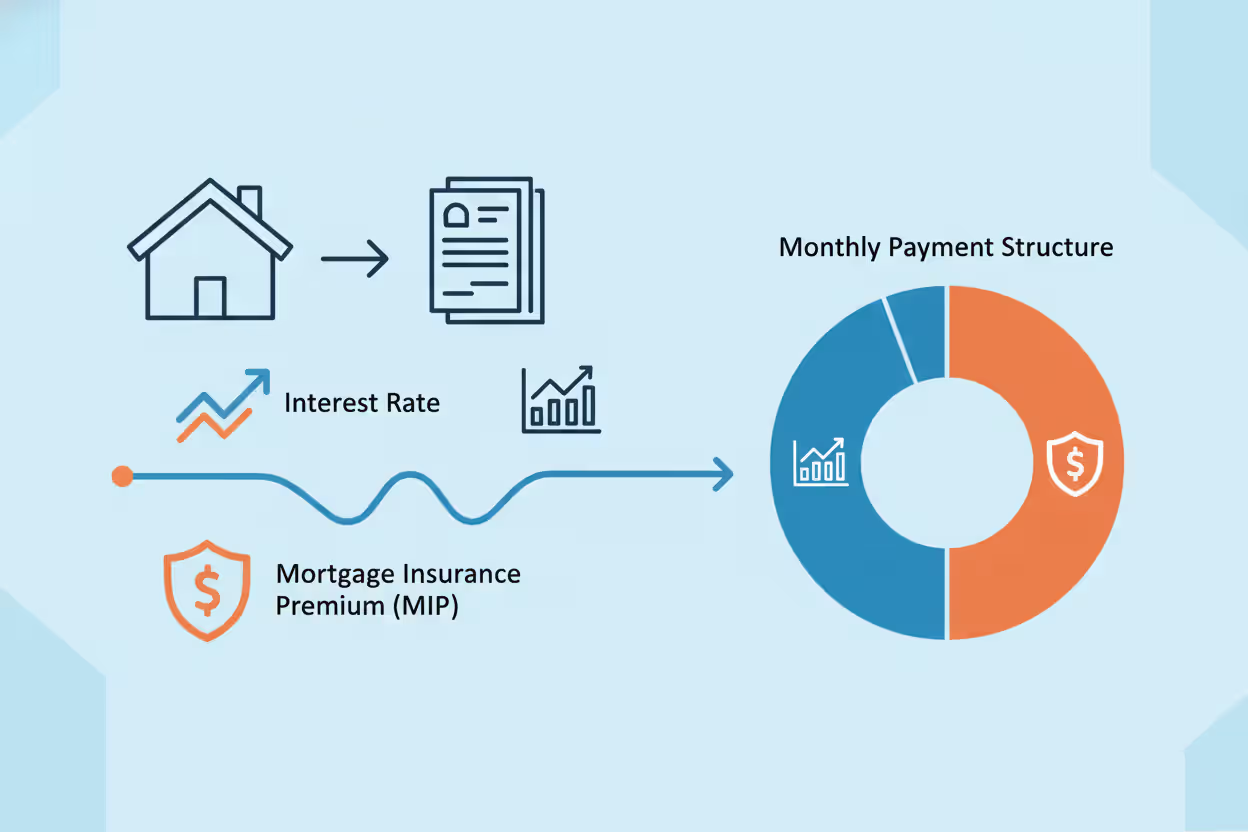
When you take out an FHA loan, you're actually dealing with two separate costs: the interest rate itself and the mortgage insurance premium (MIP). The MIP comes in two forms—an upfront premium of 1.75% of the loan amount, typically rolled into your mortgage, and an annual premium that ranges from 0.45% to 1.05% depending on your loan amount, loan-to-value ratio, and term. This annual premium gets divided into monthly payments added to your mortgage bill.
Author: Hannah Whitlock;
Source: isomfence.com
Many borrowers mistakenly focus only on the interest rate while overlooking how MIP affects their total monthly payment. A loan with a slightly higher interest rate but lower MIP might cost less overall than one with a rock-bottom rate but maximum insurance premiums.
FHA loans come in both fixed-rate and adjustable-rate versions. Fixed-rate mortgages lock your interest rate for the entire loan term—typically 15 or 30 years—providing payment stability. Adjustable-rate mortgages (ARMs) start with a lower initial rate that remains fixed for a set period (commonly 5, 7, or 10 years) before adjusting annually based on market indexes. ARMs can make sense if you plan to sell or refinance before the adjustment period begins, but they carry more risk if rates climb.
The relationship between your interest rate and MIP creates a unique dynamic. Unlike conventional loans where you can eliminate private mortgage insurance once you reach 20% equity, most FHA loans originated after 2013 require MIP for the life of the loan if you put down less than 10%. With a 10% or larger down payment, you can drop MIP after 11 years. This long-term insurance cost often outweighs any initial rate advantage, making refinancing to a conventional loan worthwhile once you build sufficient equity.
What Determines Your FHA Rate
Lenders evaluate multiple factors when pricing your specific FHA loan. While the FHA sets minimum standards, each lender maintains its own pricing adjustments based on risk assessment and business strategy.
Your credit profile sits at the top of the list. The FHA accepts borrowers with credit scores as low as 500 (with 10% down) or 580 (with 3.5% down), but lenders typically add significant rate premiums for scores below 640. Two borrowers applying for identical loan amounts on the same day can receive rate quotes differing by a full percentage point or more based solely on credit scores.
Down payment size influences both your rate and your MIP. While the minimum 3.5% down payment makes FHA loans accessible, putting down 5%, 10%, or even 15% can reduce your rate slightly and—at the 10% threshold—shorten your MIP duration dramatically.
Loan term matters significantly. Fifteen-year FHA loans typically carry rates 0.25% to 0.75% lower than 30-year versions, plus they have lower annual MIP (0.45% versus 0.85% for most borrowers). The monthly payments run higher due to the compressed payoff schedule, but you'll pay far less interest over time.
Your debt-to-income ratio (DTI) affects approval more than pricing, but borrowers pushing the FHA's maximum 50% DTI may face rate adjustments from cautious lenders. Keeping your DTI below 43% generally avoids these penalties.
Property type introduces another variable. Single-family homes get the best rates, while two- to four-unit properties face rate increases of 0.125% to 0.375%. Condos require FHA approval of the entire complex, and units in non-approved buildings simply can't get FHA financing regardless of the buyer's qualifications.
Geographic location creates rate variations due to local market conditions, property values, and lender competition. Borrowers in high-cost areas sometimes see slightly better rates because larger loan amounts generate more lender revenue, though this advantage is modest.

Author: Hannah Whitlock;
Source: isomfence.com
Credit Score Impact on FHA Pricing
Credit score tiers create distinct pricing breaks. A borrower with a 720 score might receive a rate 0.50% to 0.75% lower than someone with a 620 score, all else being equal. That difference on a $300,000 loan translates to roughly $100 to $150 in monthly savings and $36,000 to $54,000 over 30 years.
Lenders typically group scores into ranges: 580-619, 620-659, 660-699, and 700+. Each jump to the next tier unlocks better pricing. Borrowers sitting just below a threshold—say, at 658—should strongly consider delaying their application to cross into the next tier. A few months of paying down credit card balances and avoiding new inquiries can boost your score enough to qualify for a meaningfully better rate.
Recent derogatory marks hurt more than old ones. A bankruptcy from three years ago impacts your rate more severely than one from six years ago, even if your current score has recovered. FHA allows borrowers to qualify just two years after a bankruptcy discharge (three years after foreclosure), but expect rate premiums until more time passes.
Down Payment and Rate Relationship
The difference between 3.5% and 5% down rarely moves your interest rate much—perhaps 0.0625% (one-sixteenth of a point) if at all. But crossing the 10% threshold changes the equation substantially by cutting your MIP timeline from the full loan term to just 11 years.
Consider a $350,000 purchase. With 3.5% down ($12,250), your loan amount is $337,750 with lifetime MIP at 0.85% annually ($2,871 per year). With 10% down ($35,000), your loan drops to $315,000 and MIP falls to 0.80% annually ($2,520), but you eliminate it entirely after 11 years. That MIP removal saves you $2,520 every year for the remaining 19 years of your loan—nearly $48,000 in total.
The math gets more complex when you factor in the opportunity cost of tying up additional cash in your down payment versus investing it elsewhere, but for most borrowers, the 10% down payment sweet spot delivers substantial long-term savings.
Average FHA Home Borrowing Rates in 2026
As of early 2026, typical FHA rates for well-qualified borrowers with credit scores above 700 range from 5.75% to 6.25% for 30-year fixed mortgages and 5.00% to 5.50% for 15-year fixed loans. These rates reflect the Federal Reserve's monetary policy stance and broader economic conditions affecting all mortgage types.
Borrowers with credit scores in the 660-699 range typically see rates 0.25% to 0.50% higher, while those in the 620-659 band face another 0.25% to 0.50% increase. Scores below 620 push rates up an additional 0.50% to 1.00%, assuming the lender approves the loan at all.
| Credit Score Range | 30-Year Fixed Rate | 15-Year Fixed Rate | Estimated APR (with MIP) |
| 700+ | 5.875% | 5.125% | 7.125% |
| 660-699 | 6.250% | 5.500% | 7.500% |
| 620-659 | 6.625% | 5.875% | 7.875% |
| 580-619 | 7.250% | 6.500% | 8.500% |
Note: Rates shown are representative examples for comparison purposes. Actual rates vary by lender, location, and individual borrower circumstances. APR includes estimated annual MIP of 0.85% for 30-year loans and 0.45% for 15-year loans.
Historical context helps frame these numbers. FHA rates bottomed out in late 2020 and early 2021, with well-qualified borrowers securing 30-year loans below 3.00%. Rates climbed sharply through 2022 and 2023 as the Federal Reserve fought inflation, peaking above 7.50% in late 2023. The gradual decline through 2024 and 2025 brought rates back to the mid-6% range, and early 2026 has seen further modest decreases.
Rate forecasts remain uncertain. If inflation stays controlled and economic growth moderates, rates could drift slightly lower through 2026. A recession might push rates down more substantially, while renewed inflation or increased government borrowing could reverse recent declines.

Author: Hannah Whitlock;
Source: isomfence.com
FHA vs. Conventional Mortgage Rates
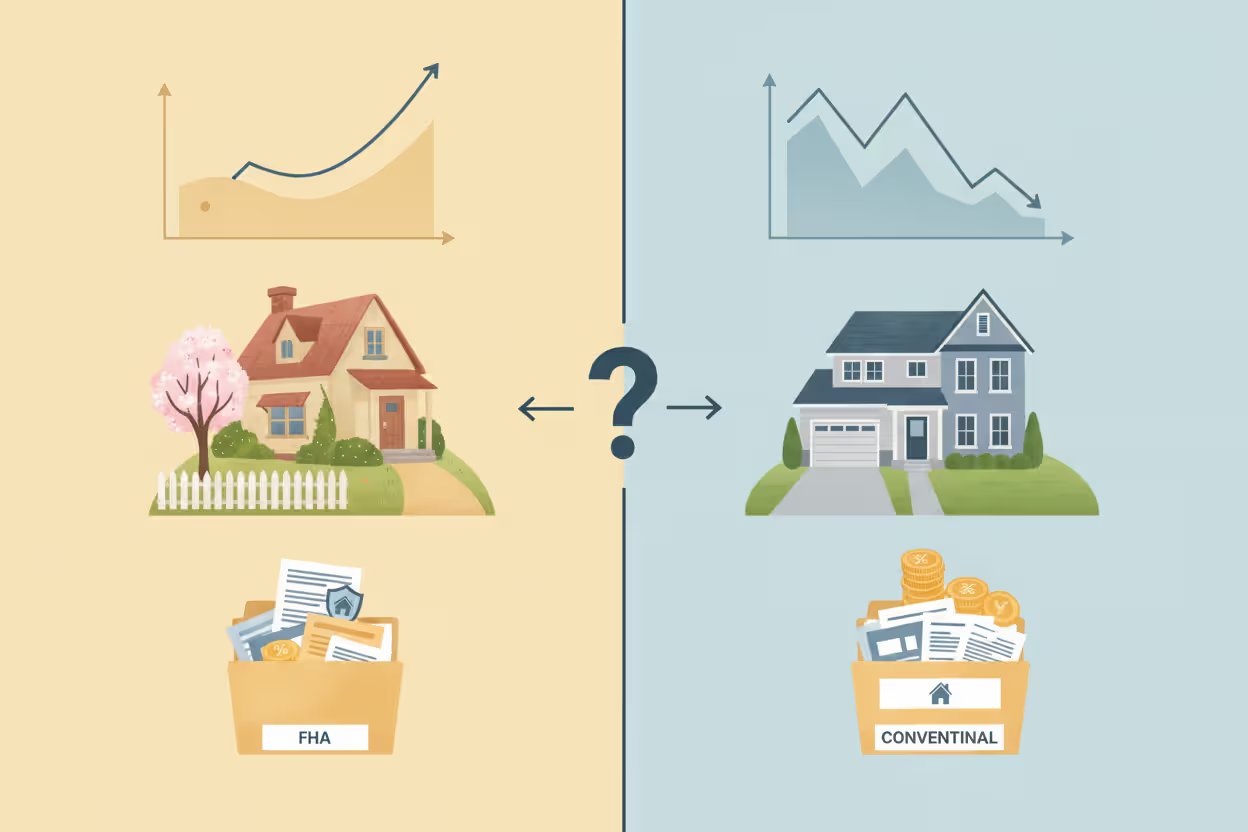
The rate comparison between FHA and conventional loans isn't straightforward because the answer depends heavily on your credit profile and down payment.
Borrowers with excellent credit (740+) and substantial down payments (20% or more) almost always get better rates on conventional loans. A conventional lender might offer 5.625% where an FHA lender quotes 5.875%, and the conventional loan eliminates mortgage insurance entirely with 20% down. The FHA loan's mandatory MIP makes it significantly more expensive in this scenario.
For borrowers with credit scores between 640 and 700 putting down 5% to 10%, the rates often run nearly identical, but the total cost calculation favors one or the other depending on specific circumstances. FHA MIP continues for the loan's life (or 11 years with 10% down), while conventional PMI typically drops off once you reach 20% equity. However, conventional PMI rates for borrowers in this credit range can exceed FHA MIP rates, especially in the early years.
Borrowers with credit scores below 640 find FHA loans substantially more accessible. Many conventional lenders either decline these applications or price them so aggressively that FHA becomes the clear winner. A borrower with a 620 score might face a conventional rate of 7.50% with 1% in additional fees, while an FHA lender offers 6.625% with standard costs.
The break-even analysis requires calculating total payments including insurance over your expected holding period. If you plan to sell or refinance within five years, FHA might cost less even with lifetime MIP because you'll exit before the long-term insurance burden accumulates. If you're buying your forever home with marginal credit, a conventional loan with removable PMI could save you tens of thousands despite a slightly higher initial rate.
One often-overlooked factor: FHA loans allow the seller to contribute up to 6% of the purchase price toward your closing costs, while conventional loans cap seller concessions at 3% (with less than 10% down) or 6% (with 10%+ down). For cash-strapped buyers, this flexibility can make FHA the only viable option regardless of rate comparisons.
Author: Hannah Whitlock;
Source: isomfence.com
How to Get the Best FHA Rate
Shopping multiple lenders represents the single most effective way to secure a competitive rate. Rate quotes for identical borrowers can vary by 0.25% to 0.50% or more between lenders due to different business models, overhead costs, and profit targets.
Contact at least three to five FHA-approved lenders and request loan estimates on the same day. Rates change daily, so simultaneous quotes ensure you're comparing apples to apples. Don't just compare interest rates—examine the annual percentage rate (APR), which incorporates fees and gives a more complete cost picture.
Improving your credit score before applying pays immediate dividends. If you're sitting at 658, waiting two months to cross into the 660-679 tier could reduce your rate enough to save $75 monthly on a $300,000 loan. Pay down credit card balances below 30% of limits (10% is even better), dispute any errors on your credit reports, and avoid opening new accounts or making large purchases before and during the mortgage process.
Rate locks protect you from increases between application and closing. Most lenders offer 30-, 45-, or 60-day locks at no cost, with longer periods requiring a fee. If rates are trending upward, lock early. If they're falling, you might delay locking or negotiate a "float-down" option that lets you capture lower rates if they drop before closing, though this feature typically costs extra.
Discount points allow you to prepay interest to reduce your rate. One point (1% of the loan amount) typically lowers your rate by 0.125% to 0.25%. On a $300,000 loan, paying $3,000 for one point might reduce your rate from 6.125% to 5.875%, saving roughly $45 monthly or $16,200 over 30 years. The break-even point arrives around 67 months (just under six years). Points make sense if you'll keep the loan long enough to recoup the upfront cost, but they're a poor investment if you'll refinance or sell within a few years.
Timing your application strategically can help, though predicting rate movements is notoriously difficult. Rates tend to be more favorable when economic reports show weakness (suggesting the Fed might lower rates) and less favorable when inflation data runs hot. Avoid applying during periods of market volatility when rates swing wildly day-to-day.
Consider working with a mortgage broker who can shop multiple lenders on your behalf. Brokers access wholesale rate sheets unavailable to retail borrowers and can often secure better pricing, though you'll pay a broker fee (typically 0.5% to 1% of the loan amount). Compare the broker's total cost against direct lender quotes to ensure you're getting value.
Common FHA Rate Mistakes to Avoid
Accepting the first rate quote you receive costs many borrowers thousands of dollars. Lenders know most applicants won't shop around, so initial quotes often include extra profit margin. Simply mentioning you're comparing offers frequently prompts lenders to sharpen their pencils and offer better terms.
Focusing exclusively on interest rate while ignoring total loan costs creates a false economy. A lender offering 5.875% with $8,000 in fees delivers a worse deal than one quoting 6.00% with $4,000 in fees if you'll keep the loan for less than a decade. Always compare APRs and total costs, not just rates.
Misunderstanding MIP's impact leads borrowers to underestimate their true monthly payment. A 6.00% rate sounds manageable until you add 0.85% annual MIP (divided into monthly payments), which increases your effective rate to approximately 6.85%. Run payment calculations including MIP to avoid surprises.
Neglecting to improve your credit before applying leaves money on the table. Borrowers who rush into applications with 645 scores when three months of effort could boost them to 670 pay premium rates for 30 years to save a few months on the front end. Unless you're facing a time-sensitive situation (lease expiration, seller deadline), take time to optimize your credit profile.
Poor timing around rate locks creates unnecessary risk. Locking too early when rates are falling means you miss out on decreases (unless you paid for float-down protection). Failing to lock when rates are rising or when you're within 45 days of closing exposes you to potentially significant payment increases if rates jump before your loan closes.
Overlooking the refinance option traps borrowers in high-rate loans. If you took out an FHA loan at 7.25% in 2023 and rates have since dropped to 6.00%, refinancing could save you hundreds monthly. Many borrowers assume refinancing costs too much or takes too long, but FHA streamline refinances require minimal documentation and can close in 30 days with costs that pay for themselves within a year or two.
Choosing 30-year terms by default without considering 15-year options costs substantial interest. Yes, 15-year payments run higher—roughly 30% to 40% more monthly on the same loan amount—but you'll pay less than half the total interest and build equity much faster. If your budget can absorb the higher payment, the long-term savings are dramatic.
Many borrowers fixate on getting the lowest possible rate without understanding how FHA mortgage insurance affects their true cost of borrowing. A conventional loan with a slightly higher rate but no lifetime insurance requirement often delivers better long-term value once you've built 20% equity. The key is matching the loan type to your specific credit profile and homeownership timeline
— Jennifer Martinez
Frequently Asked Questions
Understanding FHA home loan interest rates requires looking beyond the advertised number to the complete cost picture including mortgage insurance, loan term, and your personal financial situation. The government backing that makes FHA loans accessible doesn't automatically make them the cheapest option for everyone, but for borrowers with limited savings or credit challenges, they remain an invaluable path to homeownership.
Your credit score drives your rate more than any other single factor within your control. Even modest improvements—say, from 655 to 680—can reduce your rate enough to save tens of thousands over your loan's life. If your timeline permits, invest a few months in credit optimization before applying.
Shopping multiple lenders isn't optional if you want the best deal. Rate and fee variations between lenders on identical loans can cost or save you $50 to $150 monthly, which compounds to $18,000 to $54,000 over 30 years. Request loan estimates from at least three lenders on the same day and compare APRs, not just interest rates.
Consider the full timeline of your homeownership plans. If you're confident you'll refinance within five years (perhaps once your credit improves or you build equity), a slightly higher FHA rate with lifetime MIP might cost less than a conventional loan with higher upfront costs. If you're buying a long-term home, factor in that MIP burden extending decades into the future.
The best FHA rate is the one that aligns with your financial reality—not just today's payment, but the total cost over your expected holding period. Take time to run the numbers, understand the trade-offs, and make an informed choice that supports your broader financial goals.
Related Stories

Read more
Read more




The content on this website is provided for general informational and educational purposes only. It is intended to explain concepts related to home loans, mortgage rates, home equity loans, and the home buying process.
All information, including articles, guides, and explanations, is provided for general educational purposes only. Mortgage terms, interest rates, eligibility requirements, and lending conditions may vary depending on individual financial situations, lenders, and regional regulations.
This website does not provide financial, legal, or mortgage advice, and the information presented should not be considered a substitute for consultation with qualified financial professionals, lenders, or advisors.
The website and its authors are not responsible for any errors or omissions, or for any decisions made based on the information provided on this website.