

Young couple holding keys in front of their new suburban home on a sunny day
How to Avoid PMI When Buying or Refinancing a Home

Here's something most home buyers don't realize until closing day: that extra $200-$400 tacked onto your monthly payment? It's protecting your lender's investment, not yours. Private mortgage insurance represents one of the largest—yet most avoidable—expenses in homeownership.
I've watched countless buyers reluctantly accept PMI as just another cost of getting into a home. But here's the reality: with the right timing and strategy, you can sidestep this expense completely or cut it loose years earlier than your lender expects.
Your approach matters enormously. The difference between signing without a plan versus understanding your options? Potentially $50,000 or more over a 30-year mortgage. And unlike your interest rate, which you're locked into (unless you refinance), PMI offers multiple escape routes if you know where to look.
What Is PMI and Why Lenders Require It
Private mortgage insurance exists for one reason: protecting the bank if you stop making payments. You pay the premiums, but your lender collects the benefit if foreclosure happens.
Here's how lenders see it—when you put down less than 20%, they're exposed to more risk. You've got less skin in the game. If the market dips or you hit financial trouble, you might walk away more easily than someone who invested a larger chunk upfront.
Premium rates aren't one-size-fits-all. Someone with a 750 credit score putting 10% down might pay around 0.5% annually. Drop that credit score to 680 with just 5% down, and you're looking at 1.5% or higher. Take a $400,000 loan—that's anywhere from $2,000 to $6,000 yearly, breaking down to roughly $167 to $500 every single month.
This applies specifically to conventional mortgages—the ones Fannie Mae and Freddie Mac back. FHA mortgages work differently with their own insurance (called MIP, and it's often tougher to remove). VA and USDA loans have separate fee structures entirely, which we'll dig into shortly.
The magic number—20%—isn't arbitrary. Decades of lending data reveal a clear pattern: borrowers who invest at least 20% upfront default significantly less often. Your loan-to-value ratio (LTV) tells the whole story. Borrow more than 80% of your home's value? PMI automatically enters the picture unless you structure things differently.

Author: Olivia Thornton;
Source: isomfence.com
Ways to Avoid PMI at Purchase
Make a 20% Down Payment
The clearest path? Save enough to put 20% down, and PMI never appears on your paperwork. For a $350,000 home, you're looking at $70,000 at closing—not exactly pocket change.
This route demands either serious saving discipline, help from family, or proceeds from selling a previous property. First-time buyers often find this mountain impossibly steep. But combining strategies—tax refunds, work bonuses, aggressive monthly savings—can get you there over 2-3 years.
Beyond dodging insurance premiums, you're unlocking better mortgage terms. Lenders view 20%-down buyers as significantly lower risk, translating to interest rates that can be 0.25% to 0.5% lower. That rate difference compounds beautifully over 30 years.
Sellers take these offers more seriously too. In competitive markets, a 20%-down offer often beats higher-priced bids with minimal down payments because sellers know these deals close more reliably.
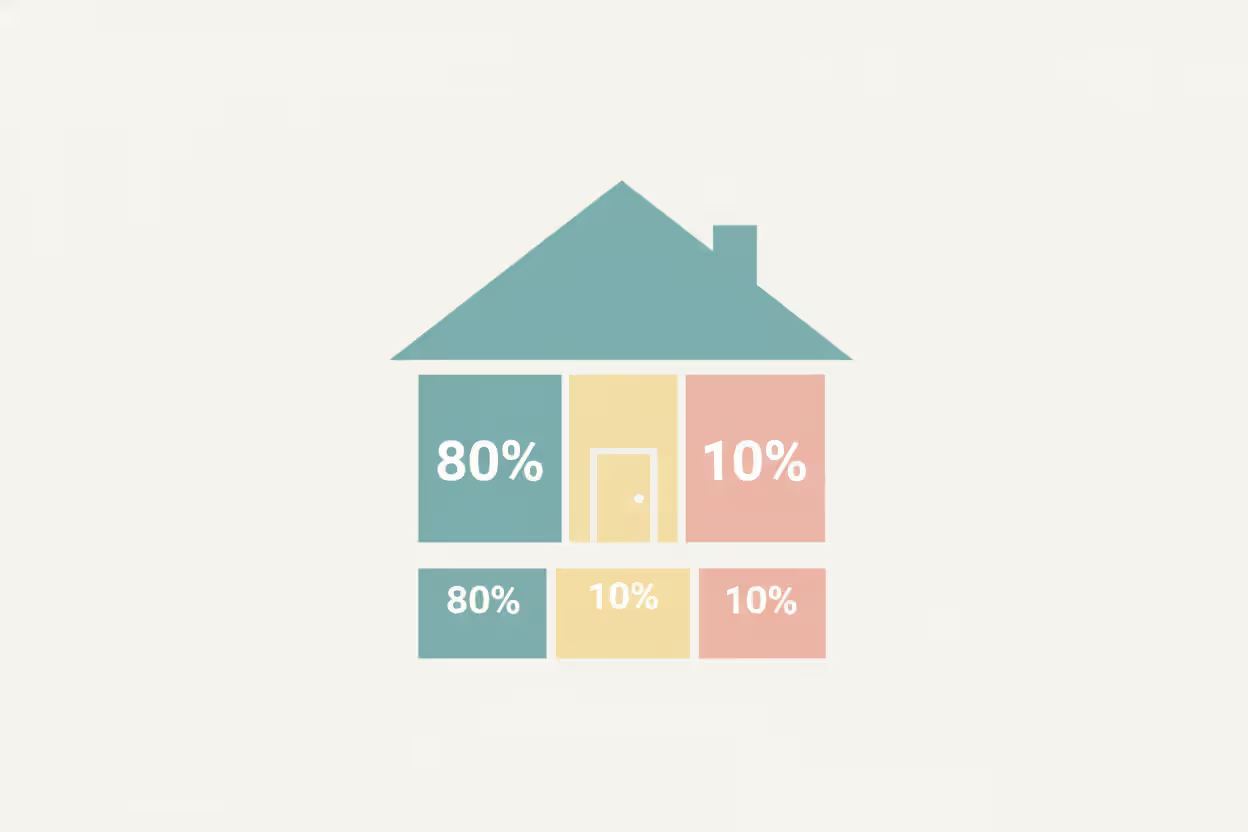
Use Piggyback Loans (80-10-10 Structure)
Can't quite reach 20%? A piggyback arrangement splits your financing across two separate loans. The first mortgage covers exactly 80% of the purchase price. A second loan (usually a home equity loan or line of credit) covers 10%. You bring the remaining 10% as your down payment.
This structure keeps your primary mortgage right at that 80% LTV sweet spot—no PMI required.
The second loan carries a steeper interest rate, typically 2-3 percentage points above your first mortgage. But here's the advantage: you can attack that smaller loan aggressively without prepayment penalties. Many homeowners pour extra payments into eliminating it within 3-5 years, then cruise with just one payment at a lower combined cost.
Run the math carefully. If your first mortgage is 6.5% and the second is 9%, you're paying that higher rate on just 10% of your total financing. Compare that against PMI calculated on your full loan amount—piggyback loans usually come out ahead.
One catch: qualifying gets trickier. Lenders evaluate whether you can handle both payments simultaneously, which might reduce your maximum purchase price compared to a single loan.
Author: Olivia Thornton;
Source: isomfence.com
Apply for Lender-Paid Mortgage Insurance
Here's an interesting twist—some lenders will cover your PMI premium themselves, then recoup the cost by adding 0.25% to 0.5% to your interest rate permanently.
No separate PMI line item on your monthly statement. Your payment looks cleaner, and your debt-to-income ratios calculate slightly better, potentially letting you qualify for more house.
The trade-off? You can't remove this cost later. Traditional PMI vanishes once you hit 20% equity. This rate increase sticks around for three decades unless you refinance. If you're planning to stay put long-term and you'll reach 20% equity within five years through normal payments, traditional PMI typically costs less overall despite the higher monthly hit initially.
This works well if you're confident you'll refinance within 3-5 years anyway—perhaps because you're expecting income growth or planning to move.
Explore VA Loans and USDA Loans
Veterans and active-duty service members get access to VA loans—zero down payment required, no PMI at all. Instead, you'll pay a one-time funding fee ranging from 1.4% to 3.6% of your loan amount (varies based on down payment and whether it's your first VA loan). This fee typically rolls into your mortgage rather than requiring cash at closing.
USDA loans target buyers in eligible rural and suburban areas who meet income requirements. These also offer zero-down financing. You'll pay an upfront guarantee fee (1% currently) plus an annual fee of 0.35%—substantially less than conventional PMI premiums. Before dismissing this option, check the USDA eligibility map. Many suburban neighborhoods surprisingly qualify, not just farmland.
Both programs represent legitimate alternatives if you qualify. VA loans particularly shine with competitive rates and flexible credit standards. USDA loans work beautifully for moderate-income households buying in smaller communities, though you'll need to verify both the property location and your household income fall within program limits.
How to Remove PMI from an Existing Mortgage
Request Cancellation at 20% Equity
Federal law gives you the right to request PMI cancellation once you've paid your loan down to 80% of the original value. You'll need to submit written notice to your servicer and demonstrate consistent on-time payments with no recent lates. Most lenders also verify you haven't taken out second mortgages or HELOCs.
Here's the critical part: "request" means you must take action. Your servicer won't proactively notify you or automatically cancel at 20%—they're legally required to do that only at 22%. Many borrowers miss this window entirely, continuing to pay for 6-12 months unnecessarily.
Pull out your amortization schedule or check your loan servicer's online portal. Mark your calendar for the month you'll cross that 80% LTV threshold, then submit your cancellation request immediately. Most servicers process these within 30 days, and your monthly payment drops the following billing cycle.
If you've been making extra principal payments to accelerate equity building, track your progress monthly. The faster you reach 80%, the sooner you can submit that request.
Automatic Termination at 22% Equity
Let's say you never request removal. Lenders must automatically terminate PMI once your balance hits 78% of the original property value—equivalent to 22% equity—based on your scheduled amortization, assuming you're current on payments.
This provides a safety net for borrowers who don't actively monitor their mortgages. But waiting for automatic termination means throwing away premiums for months beyond when you could have requested removal.
On a $300,000 original loan, that 2-percentage-point gap represents roughly $6,000 in loan balance. Depending on your PMI rate, you're paying an extra $30 to $90 monthly while waiting for automatic termination instead of requesting removal at 20%. Over 8-12 months, that adds up fast.
Refinance to Eliminate PMI
If your home's value has jumped significantly—common in hot markets—refinancing into a new loan might give you that 20% equity even though your original loan hasn't been paid down that far. Property appreciation can dramatically accelerate your escape from PMI compared to waiting for scheduled principal reduction.
This strategy makes most sense when current rates match or fall below your existing rate, delivering benefits beyond just ditching insurance. However, even if rates have ticked up slightly, calculate your break-even point: divide your closing costs by monthly savings to see how long until you come out ahead.
One consideration: refinancing typically resets your loan term. If you're five years into a 30-year mortgage and refinance into another 30-year loan, you're now paying interest for 35 total years. Consider refinancing into a 20 or 25-year term instead to maintain your original payoff timeline while eliminating insurance costs.
Order a New Appraisal to Prove Higher Home Value
Significant home appreciation since purchase creates another removal path. Order a new appraisal (expect to pay $400-$600) showing your current home value, then submit it to your servicer with a formal removal request demonstrating you now have 20% equity.
Servicer policies vary here. Most require at least two years of on-time payments before considering current value instead of original purchase price. Some mandate five years. Others evaluate case-by-case based on market conditions and your payment history.
This thrives in rapidly appreciating markets. A home purchased for $400,000 with 10% down ($360,000 loan) that's now worth $500,000? You've crossed 20% equity through appreciation alone—your $360,000 loan is just 72% of current value. The appraisal cost pays for itself within 2-3 months through PMI savings.

Author: Olivia Thornton;
Source: isomfence.com
PMI Alternatives and Their Trade-Offs
Several other structures offer different cost distributions that might align better with your specific financial picture.
Single-premium PMI pays your entire insurance obligation upfront at closing as one lump sum. This eliminates monthly premiums completely. Total interest paid over the loan term decreases substantially. But you'll need significant additional cash at purchase, and you won't recover that premium if you sell or refinance within a few years.
Split-premium PMI combines a partial upfront payment with reduced (not eliminated) monthly premiums. This middle-ground approach lowers your monthly housing cost more than standard PMI while requiring less cash at closing than single-premium.
The fundamental tension across all alternatives: timing versus flexibility. Monthly PMI costs more cumulatively but preserves cash upfront and disappears once you hit sufficient equity. Upfront options reduce total cost but lock in payments regardless of how quickly you build equity or whether you refinance.
Lender-paid structures—accepting a permanent rate increase to avoid monthly PMI—only make sense in narrow scenarios. Planning to refinance within 3-5 years? The inability to remove the rate bump matters less. Staying put 10+ years? The permanent rate increase typically costs more than removable PMI over time.

Author: Olivia Thornton;
Source: isomfence.com
Common Mistakes That Keep You Paying PMI Longer
The most expensive oversight? Not tracking your equity position. Borrowers assume their servicer will notify them when removal becomes available. But servicers earn revenue from your PMI premiums—they're not motivated to proactively cancel this income stream.
Missing your cancellation window by even six months wastes hundreds to thousands depending on your loan size. Set calendar reminders for both the 80% LTV request threshold and 78% automatic termination date using your amortization schedule.
Accepting PMI during the purchase process without exploring alternatives locks you into higher costs from day one. Many first-time buyers discover piggyback loans or lender-paid options exist only after closing. Discussing all available structures with multiple lenders during your shopping phase reveals options a single quote might not include.
Failing to request removal after home improvements or market appreciation represents another costly miss. That kitchen renovation or new shopping center in your neighborhood may have pushed your property value high enough to justify an appraisal-based removal request. You'll never know without investigating.
Not making extra principal payments when financially possible extends your timeline to natural equity buildup. Even an additional $100 monthly toward principal can shave months or years off PMI. The savings from earlier removal often exceeds returns you'd earn investing that money elsewhere, especially in today's market environment.
I've seen homeowners treat PMI like it's welded to their mortgage permanently .One client kept paying PMI for eleven years—qualified for removal after year six. The issue? Nobody told them to request it, and they didn't realize they could. That's roughly $4,200 down the drain. Here's my advice: reaching 20% equity is just step one. Step two requires action on your part. Set a reminder on your phone for when you'll hit 80% LTV based on your payment schedule. Then follow up every single month if you're getting close. Servicers won't hunt you down to stop collecting premiums—you've got to drive this process yourself
— Jennifer Martinez
Frequently Asked Questions About Avoiding PMI
Private mortgage insurance protects your lender's interests, not yours—making every strategy to bypass or eliminate it worth serious consideration. Whether you're preparing for homeownership or currently writing checks for PMI monthly, you've got options to reduce or remove this expense completely.
Start by determining your current or projected loan-to-value ratio and timeline to 20% equity. Shopping for a mortgage? Compare total costs across different structures—20% down, piggyback financing, and lender-paid options—using realistic assumptions about your actual ownership duration. The lowest monthly payment doesn't always equal the smartest financial choice over your real-world timeline.
For existing mortgages, pull your most recent statement to check your current LTV ratio. Approaching 80%? Submit written cancellation notice to your servicer immediately rather than waiting for automatic termination. Has your home appreciated significantly? Investigate whether paying for an appraisal makes financial sense given your current monthly premium.
The fastest removal strategies combine awareness with consistent action. Check your equity position quarterly, direct extra payments toward principal when possible, and mark your calendar for key thresholds. These straightforward habits can eliminate PMI years ahead of schedule, redirecting thousands of dollars toward wealth-building goals instead of insurance premiums delivering you zero direct benefit.
Related Stories

Read more

Read more




The content on this website is provided for general informational and educational purposes only. It is intended to explain concepts related to home loans, mortgage rates, home equity loans, and the home buying process.
All information, including articles, guides, and explanations, is provided for general educational purposes only. Mortgage terms, interest rates, eligibility requirements, and lending conditions may vary depending on individual financial situations, lenders, and regional regulations.
This website does not provide financial, legal, or mortgage advice, and the information presented should not be considered a substitute for consultation with qualified financial professionals, lenders, or advisors.
The website and its authors are not responsible for any errors or omissions, or for any decisions made based on the information provided on this website.