

Young couple holding house keys in front of their new suburban home with a green lawn on a sunny day
Mortgage Insurance Cost Guide for Homebuyers

Content
Content
Coming up with a 20% down payment? That's $60,000 on a $300,000 house. Most people don't have that kind of cash sitting around, which is where mortgage insurance enters the picture. You'll pay extra each month, but you'll own a home years sooner than if you kept renting and saving.
Here's what actually determines your cost and how to keep it as low as possible.
What Is Mortgage Insurance and When Do You Pay It?
Think of mortgage insurance as the price you pay for not having a massive down payment. Your lender takes on more risk when you only put down 5% or 10%, and this insurance compensates them if things go sideways and you can't make payments.
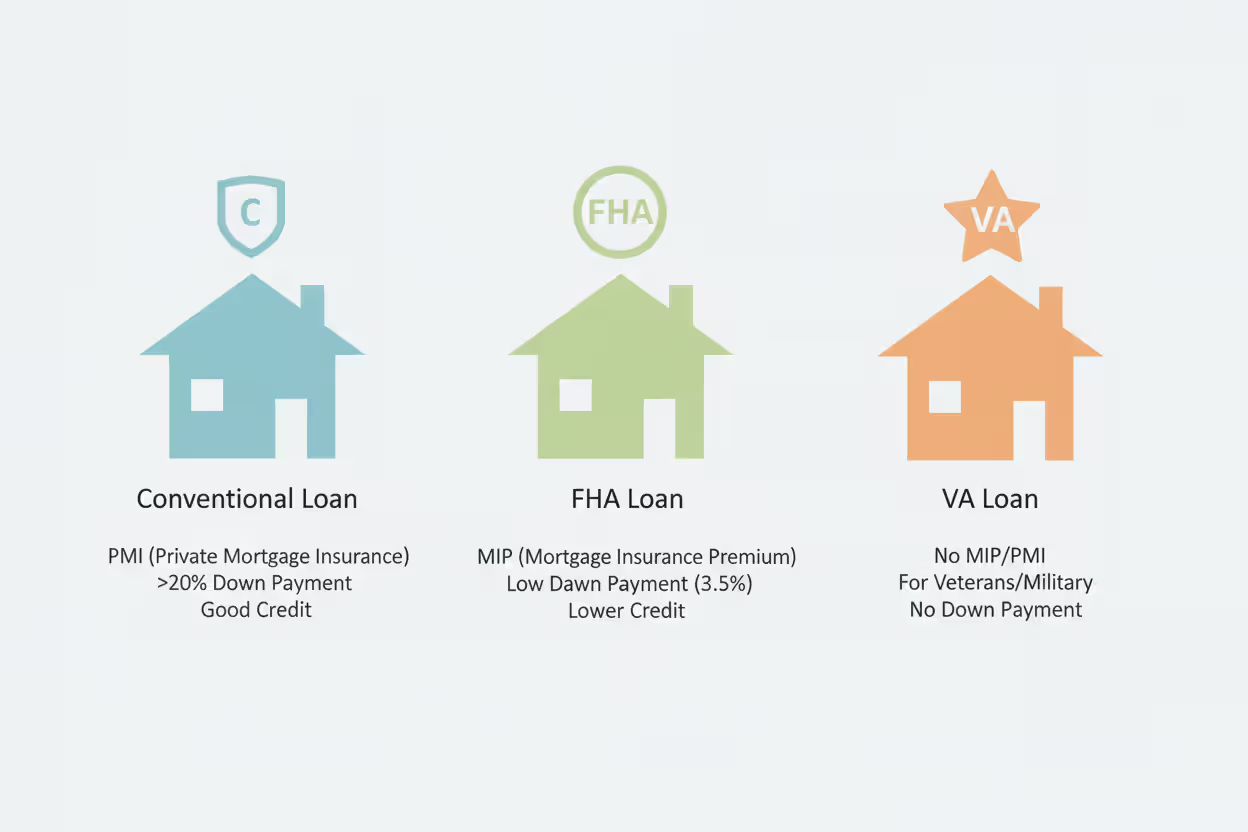
Two versions exist depending on your loan type. Conventional loans use PMI (private mortgage insurance). Government-backed FHA loans call it MIP (mortgage insurance premium). VA loans? They skip monthly insurance altogether, though you'll pay an upfront funding fee.
Author: Hannah Whitlock;
Source: isomfence.com
Here's where it gets interesting: FHA loans require insurance no matter what. Put down 15%? You're still paying MIP. That's different from conventional loans, where you avoid PMI entirely once you hit 20% equity.
Most borrowers pay monthly. The charge shows up bundled with your regular mortgage payment—principal, interest, taxes, insurance, and PMI all in one bill. Some lenders let you pay everything upfront at closing instead. Sounds appealing until you realize that's $3,000–$7,000 you can't use for furniture, repairs, or keeping your savings cushion intact.
The underwriter adds insurance to your loan automatically during approval. Got less than 20% equity? Insurance gets tacked on. No negotiating, no opt-out. Your Loan Estimate shows the exact monthly amount three days after you apply, so you'll know the damage before you're committed.
How Mortgage Insurance Is Calculated
The math itself is dead simple. Loan amount × annual rate ÷ 12 = monthly payment.
Borrow $350,000 at a 0.6% annual rate? That's $175 monthly. ($350,000 × 0.006 ÷ 12 = $175)
What determines that 0.6% rate is where things get complicated. Your loan-to-value ratio matters most. Put down just 3% and you're borrowing 97% of the home's value—that's maximum risk for the lender, so you'll pay maximum rates. Jump to 15% down and your rate could drop by half.
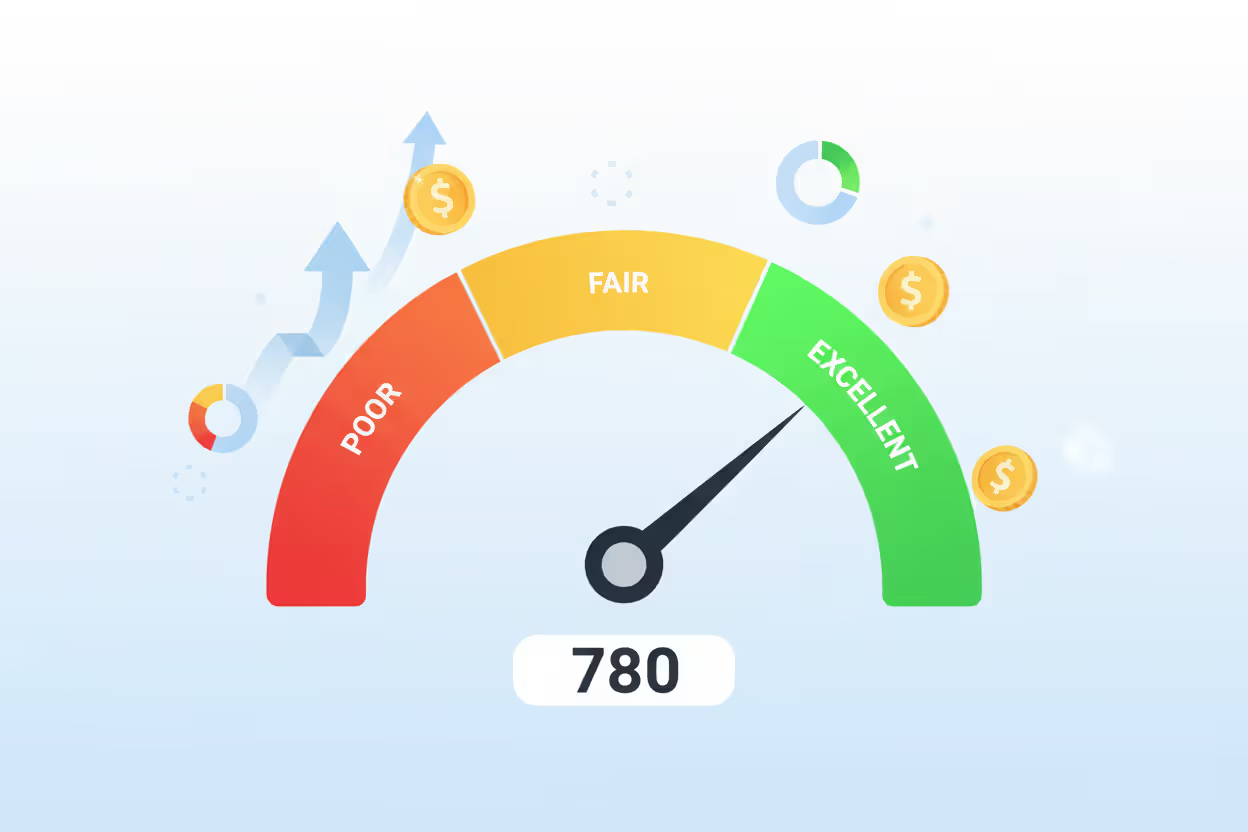
Credit scores create dramatic price swings. A 760 score might get you 0.35% while a 680 score costs 0.75% on identical loans. Below 640? Some lenders won't even quote you conventional PMI—they'll push you toward FHA instead.
Loan term plays a role too. Choose 15 years and you'll see lower rates than a 30-year mortgage. Makes sense—you're building equity twice as fast, so the lender's exposure shrinks quicker.
Property type affects pricing in ways that surprise people. That cute condo? Expect rates 0.15% higher than a single-family house. Investment properties sometimes cost double what you'd pay on a primary residence, even with identical credit and down payment.
Average Mortgage Insurance Rates in 2026
Annual rates run anywhere from 0.3% to 1.5% of your loan amount. Most borrowers land between 0.45% and 0.85%, depending on the factors we just covered.
| Loan Type | Annual Rate Range | Upfront Fee | How Monthly Payment Works | When It Ends |
| Conventional | 0.3%–1.15% | Usually none | Loan amount × rate ÷ 12 | Drops off at 78% LTV automatically; you can request removal at 80% |
| FHA | 0.55% | 1.75% of loan | Loan amount × 0.55% ÷ 12 | Sticks around for 11 years with 10%+ down; never leaves if you put down less |
| VA | No monthly cost | 1.25%–3.3% one-time | Not applicable | No monthly insurance to cancel |
| USDA | 0.35% | 1% of loan | Loan amount × 0.35% ÷ 12 | Lasts the entire loan term |
Conventional Loan PMI Rates
Conventional PMI changes drastically based on your profile. Got a 740 credit score with 10% down? You might pay 0.5% annually. Drop to a 680 score at the same down payment and suddenly you're at 0.85%.
Rates improve as you approach 20% equity. At 15% down with solid credit, you're looking at 0.35–0.45%. Hit 10% down and expect 0.55–0.75% even with excellent credit. Below 5% down, rates climb past 0.9% regardless of your score.
Lenders adjust their pricing monthly based on what's happening in the mortgage market and their own business needs. One lender quotes 0.62% while their competitor across town offers 0.48% for the exact same borrower. That gap costs you $50 monthly on a $350,000 loan—$600 per year you're basically donating if you don't shop around.

Author: Hannah Whitlock;
Source: isomfence.com
FHA Mortgage Insurance Premiums
FHA keeps things simple with standardized rates. Everyone pays 1.75% upfront (usually rolled into the loan) plus 0.55% annually for most mortgages.
That 0.55% applies to loans over $726,200 with terms longer than 15 years. Smaller loans or 15-year terms sometimes qualify for 0.50%, though the savings are modest—about $15 monthly on a $300,000 loan.
Unlike PMI, your credit score doesn't matter for FHA pricing. A 580 score pays the same rate as a 780 score. The FHA doesn't care about your credit for insurance purposes—only whether you meet the minimum to qualify for the loan itself.
That upfront premium hits hard at closing. On a $300,000 FHA loan, you're paying $5,250 (1.75% × $300,000). Most people finance it, which means your actual loan becomes $305,250. Now your monthly MIP gets calculated on the higher balance: $305,250 × 0.0055 ÷ 12 = $140 monthly.
Factors That Affect Your PMI Monthly Cost
Several variables beyond your loan amount control what you'll actually pay.
Credit score bands create step-function pricing. Jump from 719 to 720 and your rate might drop enough to save $25 monthly because you've crossed into a better pricing tier. Similarly, improving from 679 to 680 before you apply could cut your cost by 15–20%. Sitting at 717 with a mortgage application? Wait two months, improve your score past 720, and pocket the savings.
Author: Hannah Whitlock;
Source: isomfence.com
Down payment size offers your most direct control lever. Each percentage point of equity helps. Going from 5% to 10% down might reduce your monthly PMI by 40%. Push to 15% and you could halve it compared to 5%. The sweet spot often lands around 12–15% down—you've meaningfully reduced insurance costs without completely draining your bank account.
Loan terms create tradeoffs. A 15-year mortgage cuts your PMI rate, but your base payment jumps substantially. Run complete numbers on both options. Sometimes the PMI savings don't justify the higher monthly payment, especially if you'll refinance or move within five years anyway.
Property types matter more than most buyers realize. That condo might cost you 0.1–0.15% more than a house. Manufactured homes face steeper premiums still. Planning to house-hack a duplex? Expect higher rates than a single-family home, even though you're living there.
Lender overlays add hidden costs. Some lenders pad rates to boost profit margins. Others offer aggressive pricing to win your business. Three lenders could quote 0.52%, 0.61%, and 0.48% for identical scenarios. That's not random—it's different business strategies playing out in your monthly payment.
How to Estimate Your PMI Fee
Run your own numbers before house hunting so you're not blindsided during underwriting.
Start with realistic loan details. Buying a $400,000 home with 10% down? Your loan is $360,000. Check your credit score—let's say 720. For a 30-year conventional loan at 90% LTV with that score, expect roughly 0.58% for PMI.
Plug into the formula: $360,000 × 0.0058 ÷ 12 = $174 monthly. That's your baseline.
Now test alternatives. What if you scraped together 15% down instead? Your loan drops to $340,000 and your rate might fall to 0.42%, giving you $119 monthly. That's $55 in savings, but it costs you an extra $20,000 upfront.
Calculate the payback period honestly. That extra $20,000 saves you $55 monthly in PMI alone. Simple division says 364 months to break even—over 30 years. Terrible investment, right? Not so fast. You're also paying less interest on a smaller loan balance. Factor both savings and the breakeven point drops to maybe 10–12 years. Still not amazing, but more reasonable.
Online calculators work for ballpark estimates. Most lender websites have PMI calculators that spit out quick numbers. They use average rates and won't match your actual quote perfectly—expect 10–20% variance. Useful for planning, but don't base your entire budget on these tools.
Test edge cases to find leverage points. How much extra does a condo cost versus a house? What happens if your score is 680 instead of 720? Running these scenarios shows you where small changes create big impacts. Maybe improving your credit score 30 points saves more than coming up with another $10,000 for down payment.
Real-world scenario: You've saved $40,000. Put it all down (10%) on a $400,000 home and you're left with zero reserves. Or put down 8%, keep $8,000 for emergencies, and pay about $34 more monthly in PMI. That extra $8,000 cushion could save you from disaster if the HVAC dies three weeks after closing. Sometimes optimal isn't about minimizing every cost—it's about not putting yourself in a fragile position.
Ways to Reduce or Eliminate Mortgage Insurance Payments
PMI isn't permanent for most loans. Several strategies can shrink or eliminate these payments.
Build to 20% equity through payments and appreciation. Conventional loans let you request PMI cancellation at 80% LTV based on original property value. The servicer must drop it automatically at 78% LTV. Extra principal payments accelerate this—throw an additional $200 monthly at a $300,000 loan and you might kill PMI two years early, saving thousands.
Refinance when you've gained meaningful equity. Home values jumped 15% and you've paid down the balance? Refinancing into a no-PMI loan makes sense if the math works. You'll pay 2–3% of the loan amount in closing costs, so calculate whether PMI elimination justifies the expense. Generally, recovering closing costs within 24 months makes refinancing worth considering.
Author: Hannah Whitlock;
Source: isomfence.com
Explore lender-paid mortgage insurance. Some lenders pay your PMI in exchange for a slightly higher interest rate—typically 0.25–0.5% higher. This swap works if you're planning a long hold and prefer the tax treatment of interest over premiums. The catch? That higher rate never disappears, unlike PMI. Run 10-year and 15-year projections before committing.
Consider 80-10-10 piggyback loans. Put down 10%, take an 80% first mortgage and a 10% second mortgage. No PMI because your primary loan stays at 80% LTV. The second mortgage carries a higher rate, but you control when to pay it off. Works best when you've got strong income but limited cash for a bigger down payment.
FHA loans follow harsher rules. Put down less than 10% on an FHA loan originated after June 2013? MIP stays forever—literally the entire 30 years. Your only escape is refinancing to conventional once you hit 20% equity. Put down 10% or more and MIP drops after 11 years automatically.
Track your LTV ratio actively. Lots of borrowers qualify for PMI removal but never realize it because they're not paying attention. Check annually, especially in hot real estate markets. Order an appraisal ($400–600) if you think you've crossed 80% through a combination of payments and appreciation. That appraisal pays for itself immediately if it eliminates $150+ monthly insurance.
I see borrowers fixate on interest rates while ignoring PMI, but on a $350,000 loan with 5% down, you could be paying $225 monthly for mortgage insurance—that's $2,700 per year.I run scenarios showing clients how different down payments affect their total monthly payment. Sometimes adding just 2% more down payment saves enough on PMI to make it worthwhile, even if it means keeping a slightly smaller emergency fund at first
— Jennifer Martinez
Frequently Asked Questions About Mortgage Insurance Costs
Mortgage insurance costs money, but it also unlocks homeownership years earlier than saving for a full 20% down payment. The trick is knowing exactly what you'll pay and minimizing that expense strategically.
Check your credit score first and fix any problems before applying. A 20-point improvement might save $30–40 monthly. Calculate the real cost of different down payment amounts, weighing both the immediate cash hit and long-term PMI savings. Shop aggressively—PMI pricing varies more between lenders than most people realize.
After closing, track your equity position closely. Request PMI cancellation the second you're eligible. Got a bonus or tax refund? Consider a lump-sum principal payment to hit that 80% LTV threshold faster. In appreciating markets, don't wait—order an appraisal if you believe your home value has climbed enough to eliminate PMI ahead of schedule.
Mortgage insurance is a tool, not a penalty. It lets you buy with less cash upfront, building equity and stability sooner. Understanding the costs and managing them actively keeps more money in your pocket while you achieve homeownership on your timeline.
Related Stories
Read more

Read more

The content on this website is provided for general informational and educational purposes only. It is intended to explain concepts related to home loans, mortgage rates, home equity loans, and the home buying process.
All information, including articles, guides, and explanations, is provided for general educational purposes only. Mortgage terms, interest rates, eligibility requirements, and lending conditions may vary depending on individual financial situations, lenders, and regional regulations.
This website does not provide financial, legal, or mortgage advice, and the information presented should not be considered a substitute for consultation with qualified financial professionals, lenders, or advisors.
The website and its authors are not responsible for any errors or omissions, or for any decisions made based on the information provided on this website.