

Homeowners reviewing home equity loan documents at home
Home Equity Loan Terms Guide

When you tap into your home's equity through a loan, you're signing up for a repayment commitment that might stretch anywhere from five years to three full decades. Your choice of timeline isn't just about what you can afford each month—it controls how much interest you'll hand over to your lender and determines when you'll finally clear that debt from your home's title.
Getting smart about home equity repayment terms means looking beyond the basic numbers on your loan estimate. You'll need to think about your household budget right now, your financial picture five or ten years down the road, and whether paying less monthly is worth the thousands extra you'll spend in interest charges over time.
What Are Home Equity Loan Terms?
When lenders talk about your loan "term," they're referring to the repayment window—the total time span you have to pay back everything you borrowed, from your first payment to your last.
Think of it as your repayment deadline. It's completely separate from your interest rate, though these two numbers team up to determine what you'll owe each month and what the loan actually costs you when all's said and done.
Your loan term gets measured in years. Opt for a 10-year term, and you'll make 120 monthly payments before you're done. Stretch it to 15 years, and you're looking at 180 payments. The clock starts ticking the day your loan closes and the money hits your account.
Here's where home equity loans differ from HELOCs: you get all your money upfront as a single lump sum, and your payments start right away. No draw period, no interest-only phase. From month one, you're paying down both principal and interest in fixed installments.
Your term length controls two massive factors. First, it determines your monthly payment amount—shorter terms mean bigger payments, longer terms mean smaller ones. Second, it dictates your total interest expense. A brief repayment window saves you thousands in interest charges. A lengthy one costs you far more, even though each individual payment feels easier to manage.

Author: Brandon Kingswell;
Source: isomfence.com
Here's a mistake people make constantly: they confuse the term with the interest rate. Your rate determines the percentage you're charged for borrowing. Your term sets the duration you'll be making those interest-based payments. Same 6% rate on different terms? Completely different total costs.
Typical Home Equity Loan Term Lengths
Most lenders offer home equity terms between five and thirty years, though you'll find the bulk of borrowers cluster around 10, 15, or 20-year options.
Five-year terms suit borrowers who want aggressive debt elimination and have the cash flow to support hefty monthly payments. You'll mostly see these on smaller loan amounts or when someone expects a windfall—maybe selling a business, receiving an inheritance, or cashing out stock options soon.
Ten-year terms dominate the home equity market in 2026. About four in ten borrowers choose this timeframe because it splits the difference between affordable payments and reasonable interest costs. People financing kitchen remodels or consolidating credit cards tend to view their home equity loan as a medium-term obligation, not a multi-decade commitment like their original mortgage.
Fifteen-year terms attract borrowers who like the idea of matching their popular 15-year mortgage structure. These folks often prioritize debt freedom and can handle payments somewhere between the intensity of a 10-year and the ease of a 20-year term.
Twenty-year terms give you substantially more breathing room each month, which matters when you're borrowing larger amounts. The tradeoff? You'll pay dramatically more interest over that extended timeline. These longer commitments make practical sense when your borrowed funds create lasting value—like adding a rental unit to your property or building a home office that boosts your income.
Thirty-year terms exist, but they're uncommon. Many lenders won't go beyond 20 years for home equity products. Those that do typically reserve 30-year options for bigger loan amounts or specific property situations. The interest costs become staggering—you can end up paying nearly as much interest as you originally borrowed.
Geography plays a role too. Lenders in hot real estate markets with steady appreciation often provide more flexible term choices. In volatile markets where home values swing unpredictably, lenders might push borrowers toward shorter, less risky terms.
How Home Equity Loan Repayment Works
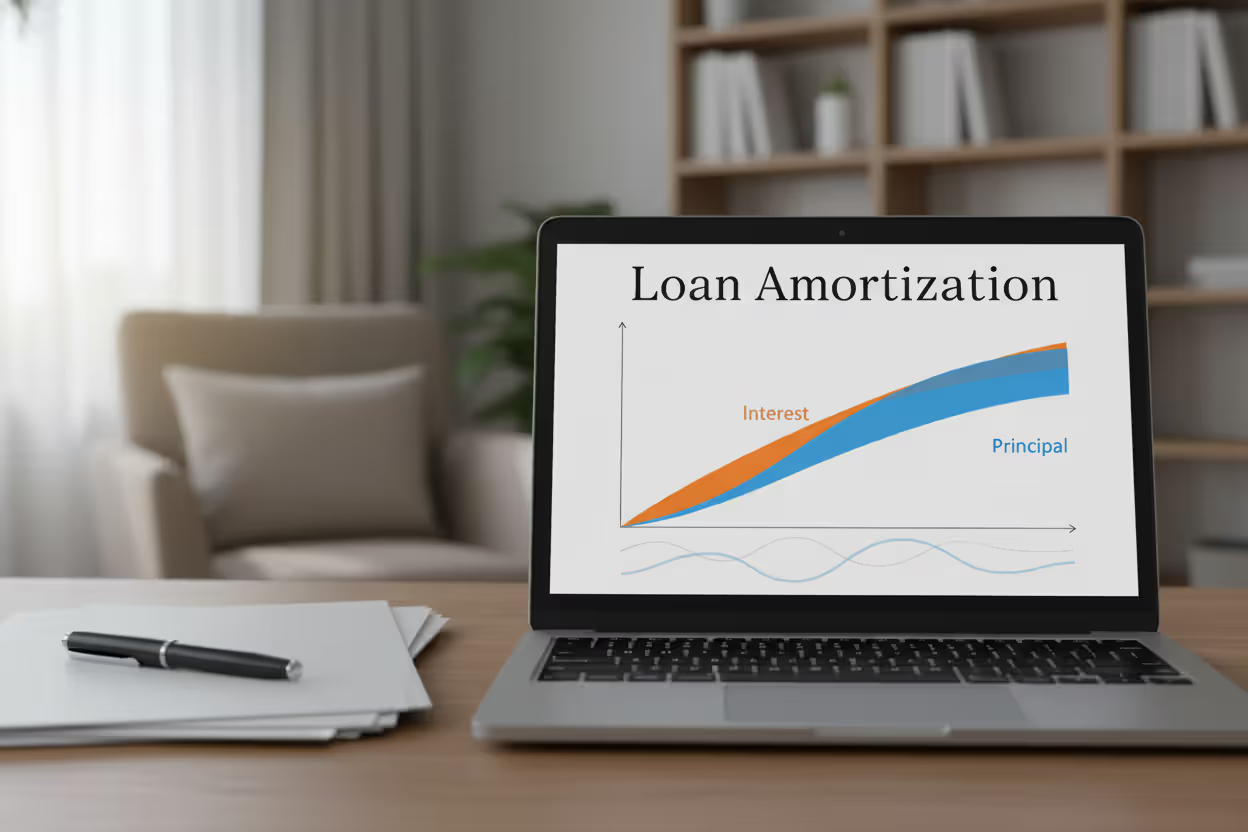
Your home equity loan follows an amortization schedule—a fancy term meaning your payment composition gradually shifts over time from mostly interest toward mostly principal. Understanding this helps you grasp how quickly you're actually rebuilding equity.
Those early years? Interest dominates your payments. Take a $50,000 loan at 7.5% over 15 years. Your first payment might break down to $312 in interest and just $154 chipping away at principal. Fast forward to year ten, and that ratio flips—now you're making serious progress on the principal balance.
Author: Brandon Kingswell;
Source: isomfence.com
This front-loading catches people off guard. They assume three years of payments on a 15-year loan means they've knocked down a decent chunk of principal. Reality check: you've barely made a dent. Sell your house or refinance early, and your remaining balance will look disappointingly high.
Your payment amount stays constant throughout the term (assuming you locked in a fixed rate), but the behind-the-scenes allocation between principal and interest shifts with every payment. This consistency makes budgeting straightforward—you'll never face a surprise increase. But it also means you can't just pay extra one month and skip the next to balance things out.
Fixed vs. Variable Rate Impact on Repayment
Fixed-rate home equity loans lock in your interest rate for the entire duration, giving you payment certainty and protection when rates climb. Your payment never budges, regardless of Federal Reserve decisions or economic turbulence.
Variable-rate home equity loans—less popular but still out there—tie your interest rate to an index like prime. These usually start with more attractive rates than fixed options but carry the risk of payment increases if interest rates trend upward. With a variable rate, your term stays the same, but your monthly payment bounces around.
Most financial advisors push fixed rates for home equity loans right now. The peace of mind outweighs any potential savings from starting with a slightly lower variable rate, especially when you're talking about a commitment spanning years or decades.
Early Payoff Options and Penalties
Plenty of home equity loans let you prepay without penalties, but don't assume yours does. Some lenders charge prepayment penalties for the first three to five years, recovering some of the interest profit they lose when you pay off early.
These penalties usually come in two flavors: either a percentage of what you still owe (commonly 2-3%) or a set number of months' worth of interest (typically three to six months). Before you sign anything, nail down whether your loan includes prepayment penalties and what triggers them.
Even without formal penalties, some lenders apply extra payments to upcoming scheduled payments instead of immediately cutting your principal. Specify that any additional payments should reduce principal directly, then verify this actually happens by checking your statements carefully.
Making extra principal payments on a penalty-free loan dramatically cuts your total interest expense. Throw an extra $100 monthly at that $50,000, 15-year loan at 7.5%, and you'll save roughly $8,200 in interest while shaving almost three years off your repayment timeline.
Factors That Affect Your Home Equity Payback Period
Lenders don't automatically offer every term length to every applicant. Several factors control which options you'll actually see and what interest rates come attached to each term.
Loan size matters significantly. Smaller loans—usually under $25,000—often face term caps, with some lenders maxing these out at 10 or 15 years. Larger loans exceeding $100,000 might qualify for longer terms, though lenders weigh this against their risk exposure.
Your credit profile directly controls your available terms. Borrowers sporting credit scores above 740 typically get access to the full menu of term options with competitive rates. Scores landing between 660 and 739 might encounter term limitations or steeper rates on longer terms. Drop below 660, and many lenders restrict you to shorter terms—assuming they approve your application at all.
Your loan-to-value ratio (LTV) affects term options more than most people expect. Borrowing against 85% of your home's value signals higher risk to lenders, potentially restricting you to shorter terms. Keep your combined LTV under 70%, and you'll generally qualify for more flexible terms with better rates.
Property type creates substantial differences. Single-family primary residences unlock the widest term selection. Investment properties or vacation homes typically face term restrictions—many lenders cap these at 15 years maximum. Condos and manufactured homes can hit similar walls depending on the lender's comfort level.
Your debt-to-income ratio (DTI) influences which terms make practical sense even when technically available. If a 10-year term pushes your DTI above 43%, lenders might recommend a longer term to improve your qualification profile—or decline your application entirely if even longer terms leave you overextended.
Where you live introduces subtle variations. Lenders operating in states with drawn-out foreclosure processes sometimes favor shorter terms to limit their exposure. Markets with unpredictable property values may prompt lenders to restrict maximum terms as a risk-management strategy.
How to Choose the Right Term Length for Your Situation

Author: Brandon Kingswell;
Source: isomfence.com
Picking the right home equity loan term demands honest self-assessment of your financial reality and objectives rather than just gravitating toward the smallest monthly payment.
Start with monthly payment affordability—the most immediate consideration. Calculate what you can genuinely sustain for the loan's entire duration, factoring in potential income changes, upcoming major expenses, and your need to maintain emergency savings. A payment that feels comfortable today could strain your finances if circumstances shift.
Give equal weight to total interest expense. Run calculations on several different terms to see the real dollar difference. That $50,000 loan at 7.5%? Over 10 years, you'll pay roughly $18,700 in interest. Stretch it to 20 years, and your interest bill climbs to about $41,000—more than double. That $22,300 difference could fund retirement contributions or college savings if you can swing the higher monthly payment.
Consider your timeline for whatever you're financing. Renovating your kitchen for immediate enjoyment and home value? A shorter term makes sense—you'll retire the debt relatively quickly. Consolidating high-interest credit cards? Think about how long you'd otherwise carry those balances, and use that as your benchmark.
Your age and career stage matter considerably. Borrowers within 10-15 years of retirement often favor shorter terms that eliminate debt before their income drops. Younger borrowers with decades of earning ahead might prioritize lower monthly obligations that free up cash for other financial goals or investments.
Don't overlook your risk tolerance. Shorter terms mean less time carrying debt secured by your home, reducing your exposure to market swings and economic uncertainty. Longer terms obligate you for decades, during which job loss, health crises, or other financial shocks could make payments tough.
The biggest mistake I see is borrowers choosing terms based solely on monthly payment comfort without calculating total interest costs. A 20-year term might feel affordable, but when clients realize they're paying nearly as much in interest as they borrowed, many wish they'd stretched for a shorter term or borrowed less
— Jennifer Martinez
Think about your competing financial priorities. Aggressively funding your 401(k) or saving for kids' college? A longer term with smaller payments might make strategic sense despite the higher interest expense. The opportunity cost of tying up cash in accelerated loan payments could exceed your interest savings.
Your plans for the property deserve consideration too. Expecting to sell within five years? A 15-year term doesn't match your timeline. But shorter terms build equity faster, boosting your proceeds when you eventually sell. Balance those higher payments against the equity acceleration benefit.
Home Equity Loan vs. HELOC Terms

Author: Brandon Kingswell;
Source: isomfence.com
HELOCs structure their repayment completely differently than traditional home equity loans, creating distinct pros and cons depending on what you need.
HELOCs typically feature a 10-year draw period during which you can borrow up to your limit, make interest-only payments, and reborrow as you pay down your balance. After this draw period expires (sometimes 5 or 15 years, depending on your lender), the repayment period kicks in—usually another 10 to 20 years.
During a HELOC's draw period, you're not touching the principal unless you voluntarily pay extra beyond the interest-only minimum. This means you could carry the same balance for an entire decade, paying nothing but interest, before actual repayment begins. From opening to final payoff, a HELOC can span 20 to 30 years total.
Home equity loans start amortizing immediately—no waiting period. Your first payment chips away at principal, and you begin rebuilding equity from day one. The term you lock in at closing sets your exact payoff date with no structural changes midway through.
That predictability appeals to borrowers who want straightforward repayment. You know your precise monthly payment and final payoff date from the moment you sign. HELOCs offer flexibility but demand more active management and introduce uncertainty when the draw period ends and payments potentially spike.
For specific, one-time expenses with known price tags—major renovations, debt consolidation, large purchases—home equity loans with fixed terms work better. For ongoing or uncertain costs—phased renovations, college tuition spread across multiple years—a HELOC's flexible structure might justify the added complexity.
Interest rate structures differ fundamentally too. Most home equity loans carry fixed rates tied to your chosen term, while HELOCs typically use variable rates that move with prime. This core difference affects your long-term planning and payment stability regardless of term length.
Comparing Home Equity Repayment Term Lengths
| Term Duration | Monthly Payment (on $50K borrowed at 7.5% interest) | Total Interest Expense | Most Suitable For |
| 5 years | $1,001 | $10,060 | Aggressive debt elimination; borrowers with high income relative to loan amount; those expecting financial windfalls |
| 10 years | $594 | $21,280 | Borrowers balancing affordable payments with reasonable interest expense; standard renovations and debt payoffs |
| 15 years | $463 | $33,340 | Those needing reduced payments while maintaining moderate duration; larger borrowing amounts where 10-year payments feel tight |
| 20 years | $403 | $46,720 | Payment affordability as top priority; situations where borrowed money creates lasting value over time |
Frequently Asked Questions About Home Equity Loan Terms
Selecting the right home equity loan term requires balancing what you can afford now with the long-term financial impact of your choice. The smallest monthly payment isn't always the smartest option when you run the numbers on total interest costs over the years.
Begin by figuring out what you can genuinely afford each month—not just what lenders will approve. Build in cushion for unexpected expenses and potential income disruptions. Then calculate total interest expenses for terms you can realistically handle, weighing the difference against your other financial goals and priorities.
Align your term with your purpose and timeline. Short-term needs fit well with short-term loans when your budget allows. Long-term value creation might justify extended terms despite the higher interest burden. Factor in your age, career trajectory, and property plans when making this call.
Examine your loan paperwork thoroughly before signing anything. Verify your exact term length, confirm whether prepayment penalties apply, and make sure you understand when your first payment comes due and when your final payment occurs. Small details buried in loan agreements can significantly impact your experience over the coming years.
The repayment term you commit to today will shape your financial obligations for years or potentially decades ahead. Take time to model different scenarios, crunch the numbers honestly, and select the option that works for both your current financial capacity and your long-term objectives. Your home equity represents substantial wealth—borrow against it with a repayment plan that makes strategic sense for your specific situation.
Related Stories

Read more

Read more




The content on this website is provided for general informational and educational purposes only. It is intended to explain concepts related to home loans, mortgage rates, home equity loans, and the home buying process.
All information, including articles, guides, and explanations, is provided for general educational purposes only. Mortgage terms, interest rates, eligibility requirements, and lending conditions may vary depending on individual financial situations, lenders, and regional regulations.
This website does not provide financial, legal, or mortgage advice, and the information presented should not be considered a substitute for consultation with qualified financial professionals, lenders, or advisors.
The website and its authors are not responsible for any errors or omissions, or for any decisions made based on the information provided on this website.