

First-time homebuyer reviewing FHA mortgage documents at a table
What Is an FHA Home Loan and How Does It Work

Saving 20% for a house down payment? That could take a decade in today's market. Meanwhile, you're watching your rent check disappear every month with nothing to show for it. That's exactly why Congress created FHA home loans back in the 1930s—and why they're still helping hundreds of thousands of buyers annually.
If you've heard whispers about "government loans" or "low down payment mortgages" but aren't sure what makes FHA different from a regular bank loan, you're in the right spot. We'll walk through what these mortgages actually involve, who they work best for, and whether the trade-offs make sense for your wallet.
FHA Home Loan Explained
Think of the Federal Housing Administration as your co-signer. When you get an FHA mortgage, the actual money comes from a regular lender—your local bank, a credit union, or an online mortgage company. What makes it "FHA" is that the government promises to reimburse your lender if you default. That guarantee is huge because it convinces lenders to say yes to borrowers they'd normally turn away.

Author: Hannah Whitlock;
Source: isomfence.com
Here's what the fha mortgage definition boils down to: it's a home loan backed by federal insurance through HUD (the Department of Housing and Urban Development). Your lender hands you the money. The FHA insurance protects them from losses. You pay premiums to keep that insurance active.
The program launched in 1934 when banks had stopped lending entirely after the Depression wiped out millions of homeowners. FHA insurance got money flowing again by reducing lender risk. Nearly 90 years later, the basic model hasn't changed—just the specific rules and dollar amounts.
What's the catch in this fha mortgage overview? Well, three things. First, you'll pay insurance premiums that conventional borrowers can eventually drop. Second, the house has to meet stricter condition requirements than typical loans demand. Third, there are caps on how much you can borrow, which vary wildly depending on whether you're buying in rural Kansas or downtown Seattle.
The FHA doesn't build houses, doesn't own houses, and doesn't directly give anyone money. It's purely an insurance program run by bureaucrats in Washington who set the rules lenders must follow.
How an FHA Home Loan Works
The application process looks familiar—you fill out forms, submit bank statements, wait for approval. But the devil's in the details, and those details can save you money or quietly drain your budget for decades.
Down payment requirements: Got a credit score of 580 or better? You can put down just 3.5%. That's $10,500 on a $300,000 purchase instead of the $15,000 minimum you'd need for most conventional loans (and way better than the $60,000 you'd need for a traditional 20% down payment). If your score sits between 500 and 579, you'll need to scrape together 10%—still potentially doable when conventional lenders won't even return your calls.
Interest rates: Rates fluctuate based on the market, your credit profile, and which lender you choose. Because of the government backing, FHA rates often come in lower than conventional rates for the same borrower—especially if your credit score is in the 600s. That doesn't mean they're always cheaper, though. Shop around.
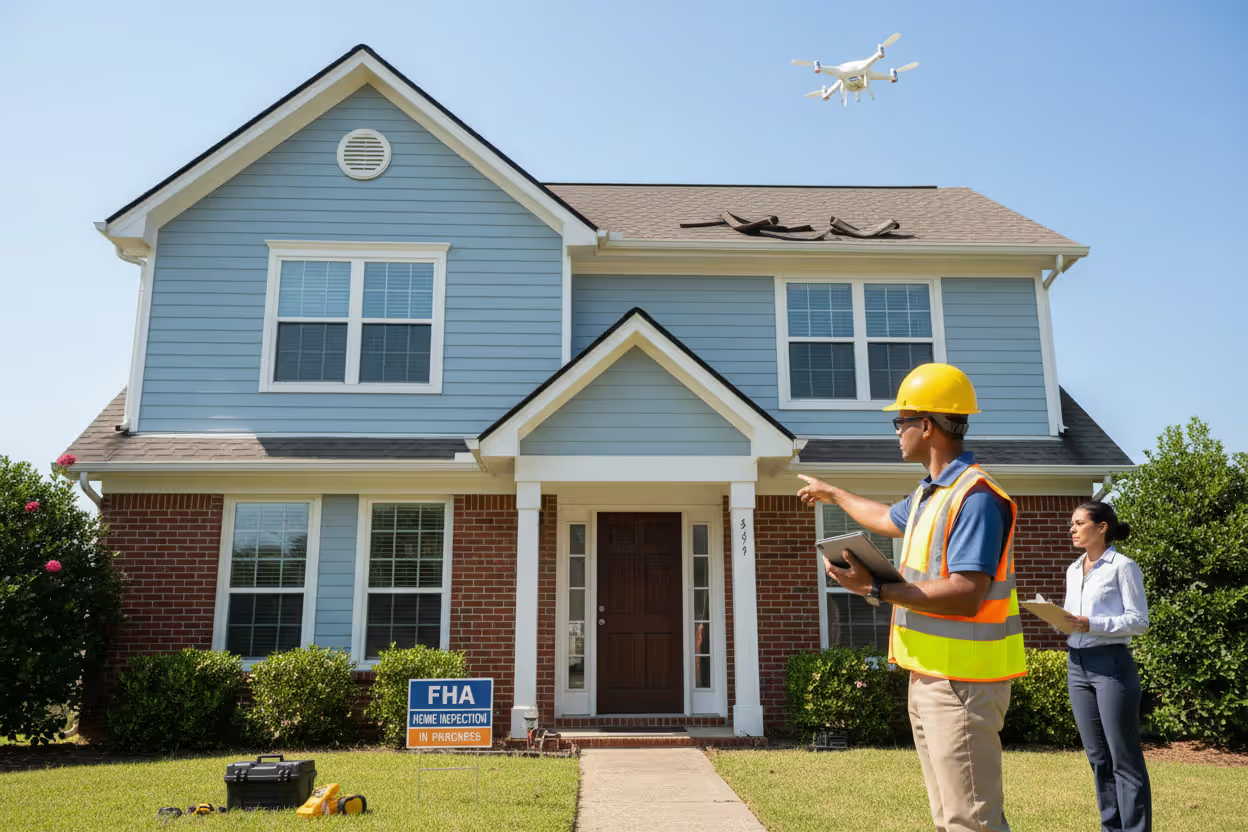
Property condition standards: Here's where deals sometimes fall apart. The FHA appraiser doesn't just estimate value—they inspect for safety hazards. Exposed wiring? Deal's off until it's fixed. Broken windows? Needs repair. Major foundation cracks? You're looking at potentially thousands in mandatory fixes before closing. Cosmetic stuff like ugly carpet doesn't matter, but anything affecting safety, soundness, or security must be addressed. This protects you from buying a disaster, but it also means forget about snagging that fixer-upper cash deal.
Author: Hannah Whitlock;
Source: isomfence.com
Loan term options: Nearly everyone picks the 30-year fixed mortgage. You can get 15-year FHA loans, and adjustable-rate versions exist, but they're uncommon enough that many loan officers will look surprised if you ask.
FHA Mortgage Insurance Requirements
Every FHA borrower pays two insurance bills, and this is where the math gets interesting.
Upfront premium (UFMIP): Right at closing, 1.75% of your loan amount gets added to what you owe. Financing $300,000? That's $5,250 tacked on. Almost nobody pays this in cash—you just roll it into the mortgage, which means you're paying interest on your insurance premium for 30 years. Fun times.
Annual premium (MIP): This one hurts more because it's permanent if you put down less than 10%. The rate varies from 0.45% to 1.05% yearly based on your loan size, term length, and loan-to-value ratio. For the typical 30-year loan with minimal down payment, figure on 0.85% annually. That same $300,000 loan? You're paying roughly $212 extra every single month. Forever. Or at least until you refinance.
Here's what trips people up: conventional loan insurance (called PMI) disappears once you've paid down to 78% loan-to-value. FHA's MIP doesn't. Put down 3.5%, and you'll pay that monthly premium for all 360 payments unless you refinance later. Put down 10% or more, and it finally drops off after 11 years—still a long time.
Do the math on a couple who finances $280,000 with 3.5% down. They'll pay about $2,380 per year in MIP. Over 30 years, that's $71,400 in insurance premiums. Ouch.
FHA Loan Limits in 2024
The FHA doesn't let you borrow unlimited amounts. In 2024, the floor limit for most counties sits at $498,257 for a single-family home. Expensive markets like San Francisco, Los Angeles, or Washington D.C. can go as high as $1,149,825.
These caps reset every year based on median home prices. If you're shopping somewhere with a $550,000 median price and the local limit is only $498,257, you'll need a different loan type. Check HUD's website and search your specific county before falling in love with anything.
Real-world impact: a buyer in rural Arkansas can use FHA for almost any house they'd want. A buyer in San Jose might find the limit too restrictive for even modest homes.
Who Qualifies for an FHA Mortgage
The fha borrowing basics are genuinely more flexible than conventional requirements—but "flexible" doesn't mean "automatic approval."
Credit score minimums: Technically, FHA allows scores as low as 500. In reality, you'll struggle to find a lender who'll work with you below 580, and most prefer 620 or higher. Each lender sets their own overlays (internal minimums above FHA's floor). Why? Because even with insurance, lenders don't want the headache of foreclosures and defaults.
If you're sitting at 640, you'll have options. At 590, expect to make phone calls and possibly pay higher rates. At 520, you might find one lender willing to work with you if you put 10% down and can document perfect payment history for the past year.
Debt-to-income thresholds: Add up all your monthly debt—car payment, student loans, credit cards, the future mortgage payment—and divide by your gross monthly income. FHA likes to see 43% or less, though some lenders approve up to 50% if you've got a solid credit score or significant cash reserves.
Example: You bring home $5,500 monthly before taxes. Your car costs $350/month, student loans run $280, and credit cards demand $120 minimum. That's $750 in existing debt. Your maximum total debt load would be $2,365 (43% of $5,500), leaving $1,615 for housing costs including principal, interest, property taxes, insurance, HOA fees, and MIP. In many markets, that's tight.
Employment verification: Two years of W-2s from the same employer looks great. Two years across two different jobs in the same industry? Still fine. Six jobs in two years? You'll need a really good explanation. Self-employed? Bring two years of tax returns showing consistent or growing income, plus a year-to-date profit and loss statement.
Owner-occupancy rules: This isn't for rental properties or vacation cottages. You're promising to live in the house as your primary home within 60 days of closing and stay for at least a year. You can buy a duplex, triplex, or fourplex and rent out the other units—that's actually encouraged—but you must occupy one unit yourself.
Past credit disasters: Here's where FHA shines compared to conventional lending. Bankruptcy? You can qualify just two years after a Chapter 7 discharge (conventional makes you wait four years). Foreclosure? Three years versus seven for conventional. You'll need to rebuild your credit and show stable income, but the door isn't permanently closed.
FHA Loans vs. Conventional Loans
Should you go FHA or conventional? Here's what you're actually comparing:
| Feature | FHA Loan | Conventional Loan |
| Minimum down payment | 3.5% with 580+ credit score; 10% with 500-579 | 3% for qualified first-timers; typically 5-20% |
| Credit score requirement | 500 floor, but most lenders want 580-620+ | Usually 620-640 minimum for approval |
| Mortgage insurance | 1.75% upfront plus 0.45%-1.05% yearly (permanent with <10% down) | 0.5%-1.5% monthly premium that cancels at 20% equity |
| Debt-to-income ratio | 43%-50% with compensating factors | Typically capped at 43%-45% |
| Property standards | Strict appraisal checking safety and structural integrity | Standard appraisal focused mainly on value |
| Loan limits | $498,257-$1,149,825 depending on county | $806,500 conforming limit for 2024 (higher in expensive areas) |
The conventional route usually wins if you've got a 680+ score, at least 10% down, and plan to stay put long enough to build equity and ditch the PMI. FHA makes more sense when your credit's recovering, your savings account is thin, or your debt load pushes the upper limits of what conventional underwriters tolerate.
Here's a scenario that actually happened: a schoolteacher with $638 credit score, $12,000 saved, and $600/month in student loans applied for both. Conventional lenders offered 5.875% with 5% down. FHA came in at 5.625% with 3.5% down. Even accounting for permanent MIP, the FHA payment was $85/month lower. She went FHA, lived there three years, refinanced to conventional once her score hit 720, and eliminated the MIP.

Author: Hannah Whitlock;
Source: isomfence.com
Pros and Cons of FHA Borrowing
What works in your favor:
- Minimal down payment: Scraping together $11,000 beats waiting five years to save $50,000 while prices and rents keep rising.
- Credit forgiveness: Had a rough patch during a divorce or medical crisis? FHA looks at your recovery, not just your past.
- Assumable feature: If rates spike to 8% in five years and you're locked in at 5.5%, a buyer can assume your loan (with lender approval). That's a huge selling point in a high-rate environment.
- Gift funds welcome: Parents can gift your entire down payment and closing costs. Some conventional loans require you to contribute at least some of your own money.
- Seller concessions: Sellers can pay up to 6% of the purchase price toward your closing costs, compared to 3% on conventional deals. In a buyer's market, that's extra negotiating room.
What might bite you:
- Permanent insurance costs: That monthly MIP on a sub-10% down payment never ends unless you refinance. Over 15 years, you could pay $35,000+ with nothing to show for it.
- Upfront premium hits your loan balance: Adding $5,250 to your mortgage means you start with less equity and pay interest on insurance from day one.
- Property appraisal can kill deals: Fall in love with a charming 1920s bungalow that needs electrical work? The FHA appraisal might torpedo your purchase unless the seller makes repairs first. In competitive markets, sellers just move to the next buyer.
- Borrowing limits frustrate expensive markets: Shopping in Denver, Portland, or Boston? You might exceed the county cap and get forced into conventional or jumbo territory anyway.
- Competitive disadvantage: Some sellers and their agents view FHA buyers as higher-risk—more likely to have financing fall through due to appraisal issues. In multiple-offer situations, conventional and cash buyers often win.
Common mistake: buyers fixate on the tiny down payment without calculating long-term costs. An FHA loan with 3.5% down and permanent MIP might cost $45,000 more over ten years than a conventional loan with 5% down and cancellable PMI, even if the FHA rate is marginally better. Always run total-cost scenarios for 5, 10, and 15 years.
How to Apply for an FHA Home Loan
Step 1: Track down an approved lender. The FHA doesn't lend money, so you need a bank or mortgage company authorized to originate these loans. Most major banks participate, but not all. Credit unions often offer great rates. Online lenders can be convenient. Get quotes from at least three—rates, fees, and service quality vary wildly even though everyone's selling the same FHA product.
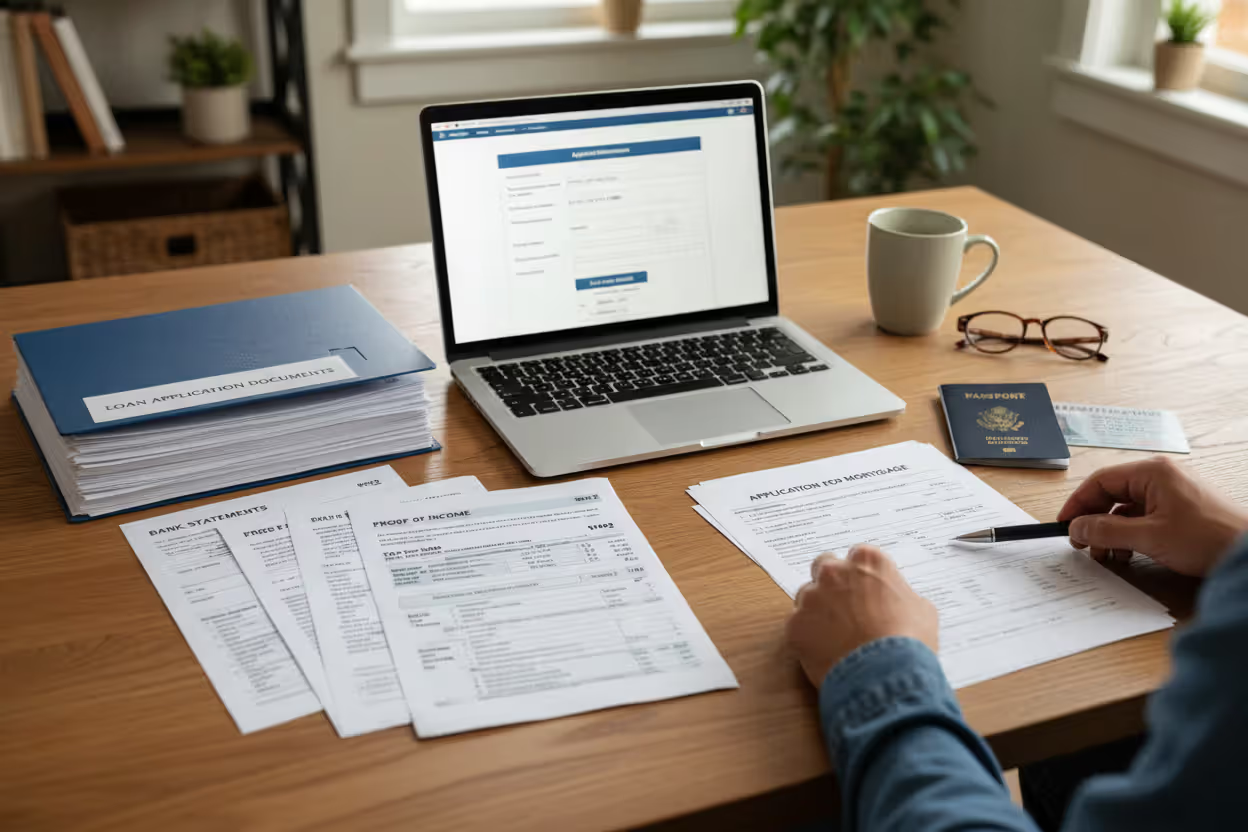
Step 2: Gather your paperwork and get pre-approved. You'll need recent pay stubs (usually two months), W-2s from the past two years, tax returns if you're self-employed, a couple months of bank statements showing your down payment funds, and permission to pull your credit. The lender crunches numbers and issues a pre-approval letter stating how much you can borrow. This takes anywhere from two days to a week depending on how responsive you are with documents.
Author: Hannah Whitlock;
Source: isomfence.com
Step 3: Start house hunting with realistic expectations. Work with an agent who understands FHA appraisal requirements—they'll steer you away from properties that won't pass inspection. Avoid anything with obvious structural issues, additions without permits, or major deferred maintenance.
Step 4: Make an offer and brace for the appraisal. Once a seller accepts your offer, your lender orders an FHA appraisal. The appraiser evaluates market value and inspects the property's condition. If they spot a cracked foundation, failing roof, or safety hazard, the seller must fix it or you renegotiate. Some sellers refuse repairs and move on—it's frustrating but common.
Step 5: Survive underwriting. The lender's underwriter reviews every document with a microscope. They'll verify employment, scrutinize bank statements for large deposits (gifts must be documented), and review the appraisal and title report. Expect requests for additional paperwork—an explanation letter for that credit inquiry last month, proof your student loans are in good standing, updated pay stubs. This phase takes one to three weeks.
Step 6: Receive clear-to-close. Once underwriting signs off, you get a Closing Disclosure showing final numbers—your interest rate, monthly payment, and closing costs. Compare it carefully to the Loan Estimate you received early on. Big changes? Ask questions before signing anything.
Step 7: Close and grab your keys. You'll sign a mountain of documents, wire your down payment and closing costs, and officially become a homeowner. The whole journey from accepted offer to closing typically spans 30 to 45 days—sometimes faster, occasionally slower if appraisal repairs drag out.
I recommend FHA loans for clients who have steady paychecks and reasonable debt but haven't had years to stockpile a massive down payment or achieve flawless credit scores. Yes, you're paying extra for mortgage insurance, but that's the price of admission when you're buying now instead of renting another three years while you save. For a lot of my clients, especially in markets where rents rival mortgage payments, that trade-off makes complete financial sense
— Sarah Mitchell
Frequently Asked Questions About FHA Mortgages
For buyers who earn decent money but haven't accumulated a huge savings pile or maintained spotless credit, FHA loans provide a legitimate path to homeownership that might otherwise stay closed for years. That combination of minimal down payment, flexible qualification standards, and competitive interest rates has helped millions of renters transition into building equity.
But FHA isn't automatically superior to conventional financing. That permanent mortgage insurance, the strict property standards, and borrowing caps mean conventional loans might actually cost less long-term for buyers with solid credit, bigger down payments, or houses in pricey markets. Your ideal choice depends on your specific credit score, how much you've saved, your current debt load, and your timeline.
Before committing either direction, model out total costs over five years, ten years, and the full loan term. Factor in the realistic possibility of refinancing later to eliminate MIP. Remember: the smartest mortgage gets you into a home you can comfortably afford while preserving enough financial cushion for emergencies and future goals—not just the one with the lowest down payment.
If FHA fits your situation, your next steps are pulling your credit report, organizing financial documents, and comparing lenders. That house you've been dreaming about might be more accessible than you realized.
Related Stories

Read more

Read more


The content on this website is provided for general informational and educational purposes only. It is intended to explain concepts related to home loans, mortgage rates, home equity loans, and the home buying process.
All information, including articles, guides, and explanations, is provided for general educational purposes only. Mortgage terms, interest rates, eligibility requirements, and lending conditions may vary depending on individual financial situations, lenders, and regional regulations.
This website does not provide financial, legal, or mortgage advice, and the information presented should not be considered a substitute for consultation with qualified financial professionals, lenders, or advisors.
The website and its authors are not responsible for any errors or omissions, or for any decisions made based on the information provided on this website.