

Couple reviewing mortgage documents with a loan officer in front of a suburban home
How Hard Is It to Get a Home Loan in 2025

Content
Content
Last Tuesday, my neighbor Sarah walked into Wells Fargo asking about $340,000 for a split-level in Tacoma. The loan officer didn't hand her a yes or no answer. Instead, she filled out an eight-page application, submitted her 2023 and 2024 tax returns, authorized a credit pull showing every payment to Capital One over the past seven years, and waited while someone verified her dental hygienist salary with the clinic's HR department.
Whether you breeze through approval or face rejection depends on specific financial metrics. Someone with 780 credit working ten years at Microsoft while paying $350 monthly on a Honda will probably close escrow in four weeks. Compare that to someone at 615 credit, eighteen months into a contracting gig, carrying $1,650 in monthly obligations across three credit cards and a Dodge Ram—that person faces months of additional documentation requests, or outright denial.
Lending standards shifted after 2020, though not uniformly. Wells Fargo might approve 610 credit scores today while demanding three months of extra bank statements. Bank of America could've relaxed their job history requirements but now caps debt ratios tighter than before. Rates swung from 5.8% up to 7.9% and back down to 6.5%, which changes what people can actually afford on a $72,000 salary.
Better approach? Learn exactly what underwriters scrutinize before submitting your first application.
What Determines Home Loan Approval

Author: Hannah Whitlock;
Source: isomfence.com
Five specific factors control whether you get funded. Fail on multiple fronts and rejection becomes likely.
Your credit score matters first. Drop below 620 and conventional mortgages become unavailable. Banks verify you've paid American Express consistently, haven't abandoned your Nelnet student loans, and carry no recent bankruptcy filings. Even one payment made 35 days late three months ago can destroy an otherwise strong application.
Income verification proves your stated earnings match reality. W-2 employees have simple documentation—recent pay stubs plus your 2024 tax return. Own a landscaping company? Prepare to provide profit-and-loss statements covering both years, business checking account records, and Schedule C forms from your taxes. Switch careers eight months ago? Expect pointed questions about whether that new paycheck will continue.
Debt-to-income ratio divides monthly obligations by gross earnings. Example: you earn $7,200 monthly. Between your Silverado payment ($420), Navient bills ($265), and Discover minimum ($185), you're paying $870 before adding housing costs. Propose a $2,300 mortgage and you've reached 44% DTI. Conventional loans typically stop at 43%. FHA might stretch to 50% if compensating factors exist.
Your down payment demonstrates financial commitment. Drop $85,000 as a 20% down payment and you've eliminated private mortgage insurance while proving you can save aggressively. Lenders overlook weaker credit or elevated debt when you're investing significant cash upfront.
Employment history confirms income stability. Two uninterrupted years in your profession is standard. Recent nursing school graduate? New professionals sometimes receive exceptions. Jumped from paralegal to insurance sales four months back? That creates problems, even with higher current earnings.
Excel across all five areas and underwriters process your file quickly. Struggle with multiple factors? Prepare for disappointing news.

Author: Hannah Whitlock;
Source: isomfence.com
Credit Score Requirements by Loan Type
Each mortgage program sets different credit thresholds. Applying for mismatched programs wastes weeks.
Conventional Loans
These non-government mortgages require 620 minimum by official guidelines. That's the technical floor, though. Realistic approval? You want 680 minimum.
Land between 620-679 and interest rates spike noticeably. We're comparing 7.1% against 6.2%. Lenders also insist on larger down payments—typically 15-20%—offsetting their additional risk. Below 620? Conventional applications get auto-rejected.
FHA Loans
Federal Housing Administration rules technically permit 500 scores. There's a catch: you need 10% down between 500-579. Reach 580 and minimum down payment drops to 3.5%.
Official rules don't reflect actual practice, though. Most banks reject anything under 580, some require 600 minimum. They layer additional requirements—called overlays—on top of FHA's baseline standards, protecting against risky borrowers. FHA mortgages also include lifetime mortgage insurance, adding $225-315 monthly.
VA and USDA Loans
VA mortgages don't specify credit minimums in published guidelines. Doesn't matter—actual lenders require 580-620 minimum. The government guarantee covering loan portions lets banks approve people carrying past bankruptcies or foreclosures, however.
USDA mortgages—zero-down financing for qualifying rural properties—typically demand 640 minimum despite looser official standards. These programs also impose income ceilings based on county. Earn above the threshold and you're disqualified regardless of perfect credit.
| Loan Type | Published Minimum Score | Realistic Lender Requirement | Standard Down Payment | Approval Sweet Spot |
| Conventional | 620 | 680 | 5–20% | Score 740+, debt consuming under 36% of income |
| FHA | 500 (580 for 3.5% down) | 580–600 | 3.5% | Score 620+, no late payments past 12 months |
| VA | None specified | 580–620 | 0% | Score 640+, consistent military or veteran income |
| USDA | 640 | 640 | 0% | Score 660+, income below county maximum |
Most rejections happen because borrowers target the wrong program. That 630 score gets declined for conventional financing but works perfectly for FHA programs.
Common Reasons Home Loan Applications Get Denied
Understanding failure patterns helps you sidestep preventable mistakes.
Excessive existing debt causes most denials. You're already sending $1,025 monthly toward your F-250 and Sallie Mae. Add a $2,650 mortgage and you've consumed 51% of your $7,200 gross income. Lenders fear you're overextended—one transmission replacement or emergency room visit and you're missing mortgage payments.
Income documentation gaps wreck self-employed applications constantly. Your 1040 shows income declining from $84,000 in 2023 to $76,500 in 2024. Major red flag. Or you wrote off $18,000 in business expenses, smart tax strategy but those deductions reduce qualifying income for mortgage calculations.
Recent credit damage includes collection accounts, charge-offs, or payments landing 30+ days late within the past twelve months. Even one missed Hyundai payment from five months ago destroys solid applications. Collections for $215 from an old Comcast bill? Requires payment before closing.
Appraisal shortages kill deals frequently. You agreed to pay $410,000 for a house. Appraisal returns at $388,000. Now you need an additional $22,000 cash or you're renegotiating price with sellers who might cancel the contract.
Employment changes within ninety days of applying create complications. Doesn't matter if your new position pays $18,000 more annually. Switched from salaried to commission-based? Lenders need two years of commission history. Moved from pharmacy tech to medical device sales? Same issue—income consistency trumps income amount.
Bankruptcies and foreclosures impose mandatory waiting periods. Conventional mortgages require four years post-bankruptcy and seven years after foreclosure. FHA reduces waiting to two years when you document extenuating circumstances—medical emergency, involuntary job loss, divorce—and successfully rebuilt credit afterward.
One underrated problem: forgetting to disclose debts. Underwriters pull credit and discover a JCPenney card carrying a $42 monthly minimum you didn't mention. Now they question your honesty about everything. Some deny immediately over undisclosed accounts.
How Your Down Payment Affects Approval Odds
Down payment size directly shifts approval probability. Drop 20% or more and you've removed private mortgage insurance requirements while demonstrating serious financial discipline. Larger down payments reduce lender risk—you own substantial equity immediately.
Hovering at 660 credit for conventional financing? Borderline territory. Increase your down payment from 5% to 15% and suddenly you become much more attractive. That additional cash compensates for credit weaknesses. Some lenders approve marginal files they'd normally reject when down payments reach 25% or above.
Minimal down payments amplify lender risk. FHA's 3.5% and conventional 3% programs help buyers without massive savings, but they require compensating strengths: exceptional credit, low debt ratios, bulletproof employment. Show weakness in these areas and low down payments transform from opportunity into automatic rejection.
PMI costs $145-290 monthly on a $330,000 loan with under 20% down. This expense inflates debt-to-income calculations. When you're already at 41% DTI, PMI pushing you to 44% separates approval from denial.
Parents can contribute money toward down payment, but banks demand extensive documentation proving it's genuinely a gift, not disguised debt. Expect signed gift letters and bank statements tracking fund origins.

Author: Hannah Whitlock;
Source: isomfence.com
Steps to Improve Your Home Loan Approval Chances
Taking deliberate action months before applying dramatically changes outcomes.
Eliminate high-interest debt aggressively. Focus on credit cards and personal loans that inflate debt-to-income calculations. Eliminate that $410 monthly Nissan payment and you've freed income for mortgage qualification. Six months before applying, redirect every available dollar toward debt elimination.
Pull credit reports hunting for errors and dispute immediately. Equifax, Experian, and TransUnion occasionally report incorrect late payments or accounts belonging to different people. Fixing these mistakes can boost scores 25-60 points. Pull free reports at annualcreditreport.com and challenge anything inaccurate that same day.
Avoid opening new credit for six months minimum before applying. Each hard inquiry temporarily reduces your score several points. Fresh accounts also lower your average credit history length, which factors into scoring models. Skip financing that living room set, decline retail store cards, and postpone new car leases when preparing for home purchases.
Boost down payment savings through any method possible. Moving from 5% to 10% strengthens your profile substantially. Set up automatic transfers into a dedicated savings account and don't touch it for any reason. Treat it exactly like a non-negotiable monthly bill.
Get pre-approved early revealing hidden problems. Pre-approval differs from pre-qualification—it requires full credit checks and income verification, exposing issues while you've got time for corrections. Pre-approvals expire after 90 days, but they establish realistic baselines for actual borrowing capacity.
Select the appropriate loan program matching your situation. Don't force conventional financing when your credit sits at 620. FHA programs deliver superior rates and easier approval paths. VA-eligible borrowers should always explore VA options first—benefits typically exceed alternatives.
Partner with mortgage brokers accessing multiple lenders. Brokers submit applications across various banks, identifying which institutions have internal policies matching your profile. Bank of America might automatically reject a 598 score while Flagstar approves it given compensating strengths.
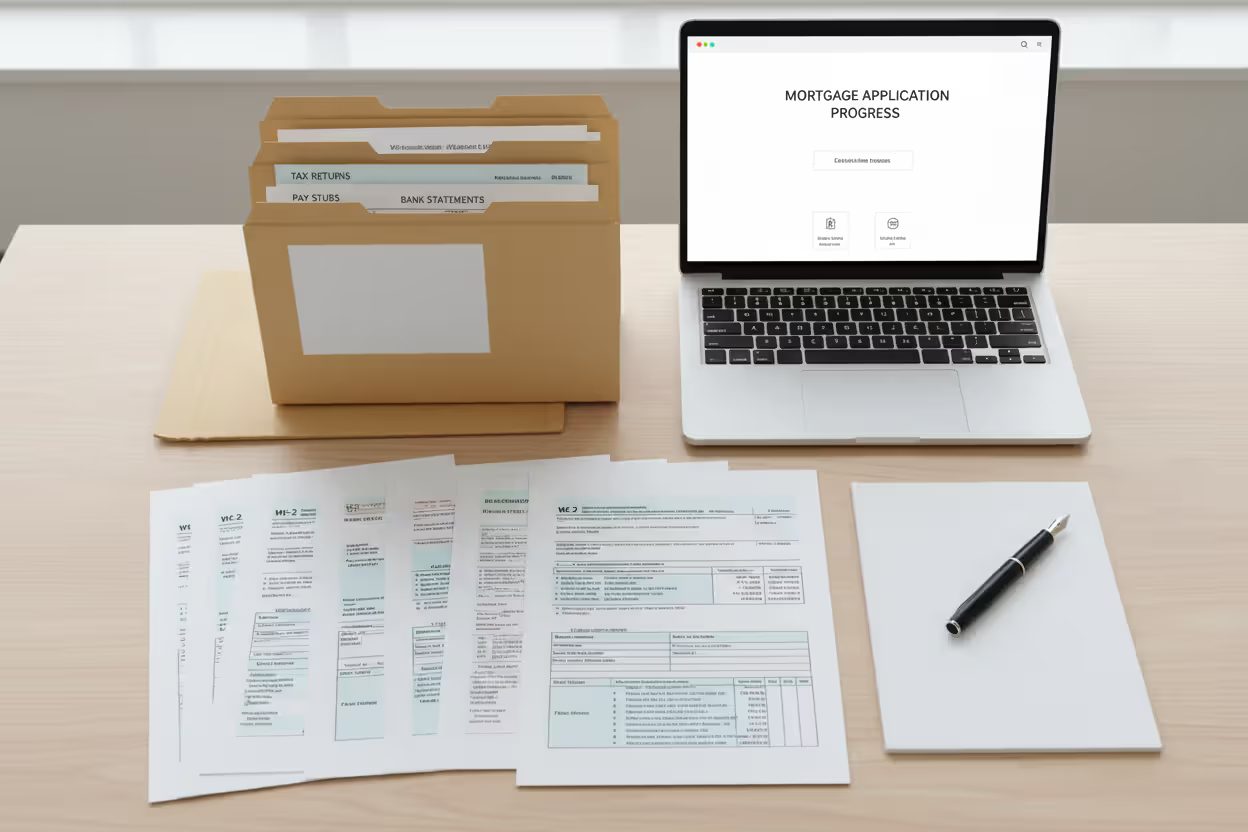
Organize documentation obsessively. Lenders request two months of bank statements, two years of tax returns, recent pay stubs, and explanation letters for unusual deposits. Having everything ready accelerates processing and demonstrates organizational competence.
Author: Hannah Whitlock;
Source: isomfence.com
How Long the Home Loan Process Takes
From initial application through closing table, expect 30-45 days on most purchase transactions. Refinances sometimes move faster—25-35 days—since purchase contract deadlines don't create pressure.
Pre-approval takes one to three days after document submission. Lenders verify income, check credit, and issue conditional approval letters specifying maximum borrowing capacity.
Home shopping and offer acceptance varies dramatically by market conditions. Competitive Seattle markets might yield results within two weeks. Slower markets like rural Kansas could stretch searching across three months. Once sellers accept your offer, formal mortgage processing begins.
Underwriting consumes 15-25 days. Underwriters scrutinize every document, order property appraisals, verify employment directly with employer HR departments, and frequently request supplemental paperwork. Complex situations—self-employment, multiple income sources, credit complications—extend this phase considerably.
Clear-to-close status confirms underwriting completion and final approval. This typically arrives three to five days before closing, allowing time for final property walkthroughs and wire transfer arrangements.
Multiple complications extend timelines: incomplete documentation, appraisal scheduling delays, title complications, last-minute credit changes. Apply for new credit, change employers, or make large unexplained bank deposits during underwriting and you'll reset timelines or trigger immediate denials.
Smooth processing hits 35-40 days. Complications frequently push closings beyond 60 days. Build extra time cushions if you're in competitive markets or have complicated finances.
The biggest mistake borrowers make is assuming approval is guaranteed once they're pre-approved. Pre-approval is conditional—everything must stay the same financially until closing. I've seen deals collapse days before closing because buyers financed furniture or changed jobs without telling us. The most impactful factor you control is maintaining financial stability throughout the process
— Jennifer Martinez
Frequently Asked Questions About Home Loan Difficulty
Getting mortgage approval in 2025 ranges from straightforward to nearly impossible based on credit scores, income consistency, existing debt levels, and available down payment funds. Applicants with 740+ credit, low debt-to-income percentages, and 20% down payments face minimal obstacles. Those carrying sub-640 scores, high existing debts, or irregular income should expect rigorous scrutiny.
Success depends on understanding lender expectations before applying and taking concrete action strengthening weak areas. Pull credit reports, reduce outstanding debts, accumulate larger down payments, and choose loan types aligning with your financial reality. FHA programs accommodate lower scores, VA options deliver unmatched veteran benefits, and conventional products reward strong credit with superior rates.
Rejection isn't permanent. Most declined applicants gain approval after addressing specific weaknesses. Partner with experienced loan officers who identify problems early and guide you toward approval paths. The mortgage process demands patience and financial discipline, but homeownership remains achievable for properly prepared borrowers.
Related Stories

Read more

Read more




The content on this website is provided for general informational and educational purposes only. It is intended to explain concepts related to home loans, mortgage rates, home equity loans, and the home buying process.
All information, including articles, guides, and explanations, is provided for general educational purposes only. Mortgage terms, interest rates, eligibility requirements, and lending conditions may vary depending on individual financial situations, lenders, and regional regulations.
This website does not provide financial, legal, or mortgage advice, and the information presented should not be considered a substitute for consultation with qualified financial professionals, lenders, or advisors.
The website and its authors are not responsible for any errors or omissions, or for any decisions made based on the information provided on this website.