

Couple reviewing mortgage documents and home listings at a table
How to Get a Home Loan in 2025

You know what nobody warns you about? Scrolling through Zillow listings and mentally decorating your future kitchen is the easy part. The real test hits when you're scrambling to prove you deserve a $400,000 loan while keeping every aspect of your financial life perfectly still for six straight weeks.
Here's the thing—lenders aren't just checking if you can swing the monthly payment. They're pulling up 24 months of job records, scanning every bank account you've opened, questioning that birthday check from Grandma, even discovering that Macy's card you signed up for to save 15% three years ago and forgot existed. One slip during their review process? You're watching your closing date slide back weeks. A major mistake means starting over from scratch.
From your first document upload to holding actual house keys takes 30-45 days minimum. The challenging part: your money situation has to stay frozen solid that entire time. We're talking six weeks where you can't switch jobs, finance a car, or even buy that sectional sofa on a 12-month payment plan without risking everything. This guide shows you exactly what happens at each stage of the home borrowing process for beginners, plus what to prepare before clicking "submit" on that first application.
What You Need Before Applying for a Home Loan
Banks measure your readiness through four specific lenses: how much you earn, your history of paying people back, the cash you're bringing today, and whether your current bills leave enough breathing room for mortgage payments.
Your credit score literally determines which programs you can access. Most conventional loans won't even consider applications below 620, though your rate drops noticeably once you hit 740. FHA programs will work with scores as low as 580 if you put down 3.5%, or they'll consider 500 if you bump that to 10%. VA and USDA don't publish hard cutoffs, but participating lenders usually want 620 minimum. Pull your reports from Experian, Equifax, and TransUnion at least three months before you start house hunting—errors pop up constantly, and fixing them takes 4-8 weeks.
Your employment timeline carries more weight than your actual salary. What lenders want to see: two solid years in the same industry. Moving up within your field? That actually helps your case. W-2 employees have it easiest—just hand over recent pay stubs, your last two W-2s, and answer a verification call from HR. Own your own business or freelance? You're in for extra scrutiny. Expect to provide two years of personal returns, business returns if you've formed an LLC or S-corp, plus a current P&L statement from your CPA. Here's the frustrating catch: every write-off that lowered your tax bill also lowers the income they'll count toward qualification.
How much you need upfront depends entirely on which program you choose. First-timers going conventional can start at 3% down. FHA wants 3.5%. Veterans with VA eligibility and buyers in USDA-approved areas can go with nothing down. But the down payment is just the beginning. Closing costs tack on another 2-5% of the purchase price, and most lenders want to see several months of mortgage payments just sitting in your accounts as safety cushion.
Your debt-to-income ratio kills more applications than anything else. Here's the math: lenders add up every monthly payment you owe—the new mortgage payment, property taxes, homeowner's insurance, HOA fees, car loans, minimum student loan payments, required credit card payments—then divide by your gross monthly income. Most programs cap this between 43-50%. There's also a front-end calculation that only looks at housing costs, usually maxed at 28-31%. Sitting right on the edge? Pay off a credit card or finish that car note before applying, not after.
Author: Olivia Thornton;
Source: isomfence.com
Steps to Get a Home Loan From Start to Finish
Getting from "I'm ready to buy" to "here are my keys" means clearing five distinct checkpoints. Each involves specific paperwork and potential roadblocks if you haven't organized properly.
Get Pre-Approved vs. Pre-Qualified
Pre-qualification is basically you telling a lender what you make and owe, and them responding "sounds like you could borrow around $X." Takes about ten minutes, needs zero proof, and sellers barely glance at it.
Pre-approval means a lender actually pulled your credit, verified your income documents, examined your bank statements, and issued a conditional commitment for a specific dollar amount. This takes 2-5 business days and requires proving everything you claimed.
Sellers spot the difference immediately. Walking into a bidding war with just pre-qual? You might as well be invisible. Pre-approval shows you've cleared the major hurdles already and can actually close the deal. The letter shows your maximum loan amount, estimated rate, and stays good for 60-90 days.
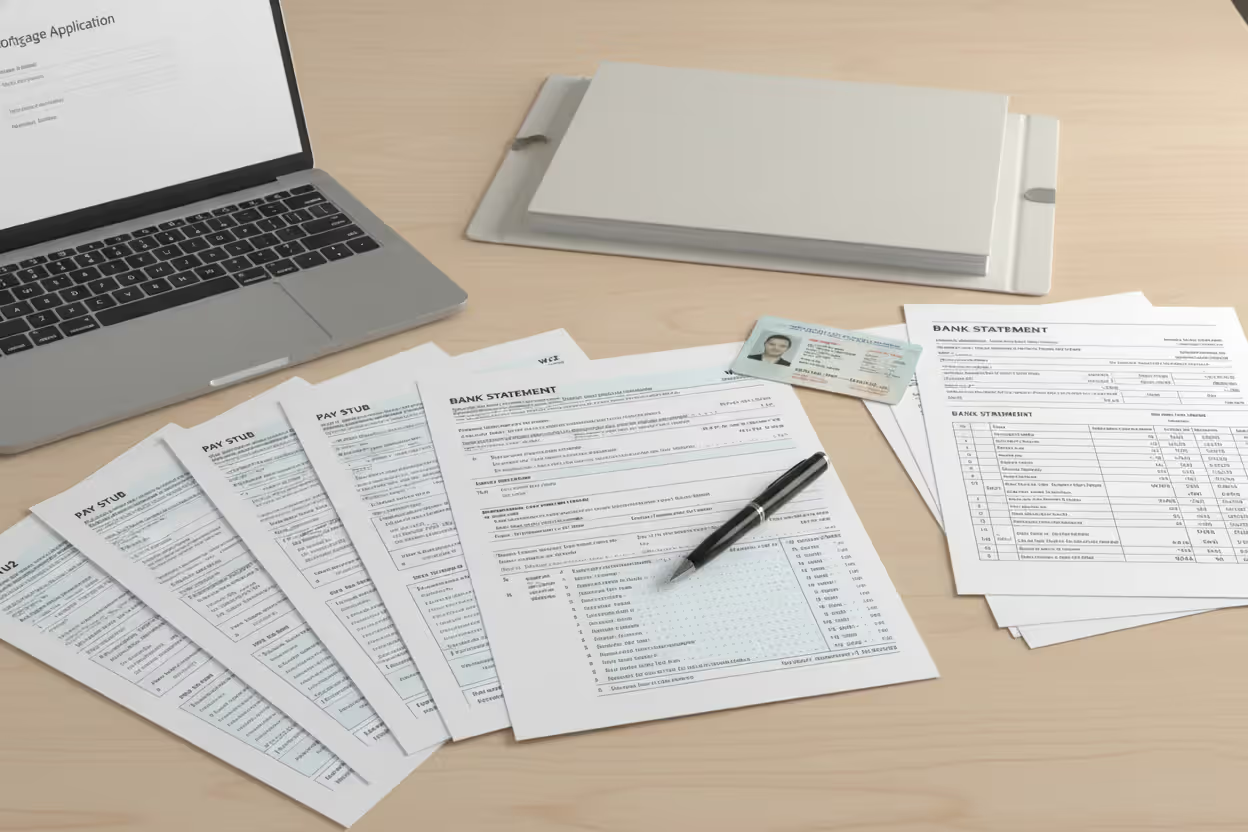
Expect to hand over recent pay stubs, your last two W-2s, statements from all your accounts, and complete tax returns. The lender verifies these basics and issues your pre-approval—though the deep-dive underwriting happens later, after you've got a signed contract.
Submit Your Formal Application
You found the house. Your offer got accepted. Time to fill out the Uniform Residential Loan Application (Form 1003)—this is where your mortgage process officially kicks off. This detailed form captures everything about the property, your finances, your work background, and anyone else on the loan.
You'll pay $300-500 right away for credit checks and appraisal. Three days later, you get your Loan Estimate—the federally required document breaking down your rate, projected monthly payment, and every closing cost. This standardized format lets you actually compare if you're shopping multiple lenders.
Speed matters enormously here. Every document your lender asks for should hit their inbox within 24 hours. Two months of bank statements. Written explanations for weird deposits. Divorce papers if applicable. Gift letters if family's helping with your down payment. Want to know the #1 reason closings get delayed? Borrowers taking three days to send back a single requested document.
Loan Processing and Underwriting
Your processor acts like the project coordinator—ordering the appraisal, requesting title searches, sometimes arranging surveys, and double-checking every detail you submitted. They call your employer to confirm you still work there. They verify those bank accounts are really yours. They make sure nothing's expired.
Then your file lands on an underwriter's desk. This person decides if the bank approves your loan. They recalculate your income using their specific formulas, hunt for hidden debts on your credit report, examine every detail under a microscope, and compare the home's value to what you're borrowing.
Underwriters always—and I mean always—request more stuff. "Explain this $2,000 deposit from March." "Send updated pay stubs since these are six weeks old now." "We need a letter about those three credit inquiries last month." This is normal. Send responses same-day when possible. Most underwriting wraps up in 7-14 days, though complex files or busy seasons push it to three weeks.

Author: Olivia Thornton;
Source: isomfence.com
Home Appraisal and Final Approval
The lender hires an independent appraiser to confirm your property is actually worth what you're paying. Appraisers measure square footage, photograph everything, pull recent sales of similar nearby homes, and issue a formal value opinion. Their number meets or beats your contract price? You move forward. Comes in low? You've got decisions to make: ask the seller to lower the price, bring more cash to cover the gap, or use your appraisal contingency to walk away.
After appraisal and final underwriting review, you receive conditional approval—basically a checklist of remaining items needed before closing. Maybe they want proof of hazard insurance. A clear termite inspection. One last employment check. Complete everything on that list, and the underwriter issues "clear to close" status. Your loan is approved. You can schedule your closing.
Closing on Your Loan
Three days before closing, the Closing Disclosure shows up. This document locks in all loan terms and lists every closing cost down to the penny. Compare it to your original Loan Estimate—numbers should match pretty closely. Big differences this late require explanation and might delay closing.
At the closing table, you'll sign a massive stack of papers. The promissory note is your legal promise to repay the money. A second document—either a mortgage or deed of trust depending on your state—gives the lender claim to your home if you default. More disclosures and affidavits round out the pile. You wire your down payment and closing costs (or bring a cashier's check—no personal checks). The title company records everything at the county courthouse, and you walk out with keys. Block out 60-90 minutes for the actual signing.

Author: Olivia Thornton;
Source: isomfence.com
How Home Financing Approval Works
Underwriting is the make-or-break moment—where your application either succeeds or crashes. Knowing what underwriters scrutinize helps you fix weaknesses before they become problems.
Four primary factors drive approval decisions: income stability (can you actually afford this long-term?), credit history (do you pay your bills?), property value (is our collateral worth enough?), and liquid assets (do you have real skin in the game?). Weakness in one area has to be offset by strength elsewhere.
Income gets analyzed conservatively. Bonuses only count if you've received them consistently for 24 months. Same rule for overtime. Commission gets averaged over two years, and any downward pattern raises red flags. Rental income from investment properties automatically gets reduced 25% for vacancy and repairs. Self-employed income comes straight from your tax returns—every write-off that saved you on taxes also reduces what they'll count for qualifying.
Credit review goes way beyond the three-digit score. Underwriters read your entire credit report like a financial autobiography. Recent late payments spell trouble, especially anything in the past 12 months. Collections and charge-offs don't automatically disqualify you, but expect to write explanations and possibly set up payment plans. Multiple recent inquiries suggest you're taking on new debt, which messes with your DTI.
The property gets independent evaluation. Underwriters analyze the appraisal to verify the comparable sales make sense, the adjustments seem reasonable, and no serious defects exist. Homes with foundation issues, broken HVAC systems, or code violations need repairs completed before closing. Unusual properties with few comparable sales sometimes trigger a second appraisal review.
Assets get traced to their source. You need documented funds for down payment and closing costs, plus reserves covering multiple months of payments based on lender requirements. Big deposits require source documentation—underwriters need proof you didn't borrow this money. Gift funds work fine, but you need a signed letter confirming it's a gift, not a loan. Retirement accounts can count toward reserves, though they typically get discounted 30% for taxes and penalties.
I'll tell you where people mess up.Pre-approval is a snapshot of your finances at that exact moment. Change jobs, lease a car, run up credit cards, let your score drop—any of these can kill your final approval. I've seen buyers lose financing three days before closing because they financed $40,000 in furniture on store credit. From application to closing, your financial picture has to stay completely frozen
— Marcus Chen
How long this takes varies by complexity. Clean conventional loans with straightforward W-2 income and solid credit usually close in 30 days. FHA and VA add 35-45 days because of required property inspections. Self-employment, complex income, or appraisal issues can stretch past 60 days.
Common Home Loan Application Mistakes to Avoid
Tiny financial moves during your loan process can nuke your approval—even after you've signed a contract and started packing boxes. These mistakes cause most 11th-hour denials.
Job changes are approval killers. Lenders verify your employment twice: during initial underwriting and again 1-2 days before closing. Change employers between those checks, and you might not qualify anymore. This gets especially dangerous if you've switched industries or moved from salary to commission. Even a lateral move in the same field can delay closing while your lender re-verifies everything. Got a job offer you can't refuse? Wait until after you close. Can't wait? Tell your loan officer immediately—some situations can be salvaged if disclosed early versus discovered during final verification.
New credit applications wreck your approval two ways. First, hard inquiries temporarily ding your score. Second, new monthly payments increase your DTI. That furniture store offering 0% financing? Underwriters count the minimum payment even if you haven't used it. Car loans create bigger problems—a $500 car payment can push a borderline DTI over the limit. From the moment you start house hunting until closing day, freeze all credit applications.
Big purchases on existing credit create identical issues. Maxing out your cards tanks your score and raises your DTI. One buyer lost approval 72 hours before closing after financing $40,000 in furniture—the extra $600 monthly payment pushed her DTI from 42% to 49%, exceeding her lender's 45% cap. Buy furniture after closing, not before.
Hiding financial obligations destroys trust and guarantees denial. Paying child support? Making payments on a personal loan? Co-signed someone's car? Disclose everything upfront. Underwriters will find it on your credit report, in your bank statements, or on your tax returns. When they discover hidden debts, they'll scrutinize your entire file and often deny you outright.
Slow document responses are the #1 reason closings get delayed. When your loan officer requests paperwork, you've got one job: deliver it within 24 hours. Taking three days or submitting incomplete documents stalls your file. Don't have a requested document? Explain why immediately instead of going silent. Processors and underwriters juggle dozens of files—responsive borrowers get priority, slow ones get pushed aside.
Cash deposits and transfers between accounts create documentation nightmares. Large cash deposits are nearly impossible to document properly—underwriters can't verify the source, so they won't count that money. Moving funds between your own accounts requires statements from both sides showing the paper trail. That $5,000 you transferred from savings to checking? Better have both statements or it looks like borrowed money.

Author: Olivia Thornton;
Source: isomfence.com
Types of Home Loans and Which One Fits Your Situation
Your program choice impacts your minimum down payment, interest rate, and what you'll pay over 30 years. Each program targets different borrower situations.
Conventional mortgages aren't government-insured and follow Fannie Mae/Freddie Mac guidelines. They offer maximum flexibility for borrowers with decent credit and provable income. First-timers can start at 3% down, repeat buyers at 5%. Put down less than 20%, and you'll pay PMI until you reach 20% equity. Conventional works for primary homes, vacation properties, and investment real estate. Best choice when your score is 700+ and you're putting down at least 5%.
FHA mortgages carry Federal Housing Administration backing and help buyers with weaker credit or limited savings. You can qualify with 580 credit and 3.5% down. The catch? Mortgage insurance hits twice—1.75% upfront plus 0.55-0.85% annually. Put down less than 10%, and that annual premium stays for the loan's entire life. FHA works well for first-timers or credit-rebuilding situations, but permanent insurance makes it expensive long-term.
VA mortgages come with Department of Veterans Affairs backing and serve eligible veterans, active military, and certain surviving spouses. Nothing down required. Zero mortgage insurance ever. This makes VA the best deal available if you qualify. You'll pay a funding fee from 1.4-3.6% of the loan amount based on down payment and whether it's your first VA loan, though disabled vets get this waived. Credit and income standards match conventional requirements. Primary residences only.
USDA mortgages get Agriculture Department backing to promote homeownership in less urban areas. Nothing down, competitive rates, but properties must fall in USDA-designated areas and borrowers can't exceed income limits (usually 115% of area median income). Expect to pay a 1% upfront fee and 0.35% annually. USDA works great for moderate earners buying in smaller cities and suburbs outside major metros.
| Loan Type | Minimum Credit Score | Down Payment | Best For |
| Conventional | 620+ | 3-5% | Solid credit, stable W-2 income, investment properties allowed |
| FHA | 580+ | 3.5% | Limited savings, rebuilding credit, first-time buyers |
| VA | ~620 (varies by lender) | 0% | Military service members and veterans, best overall terms |
| USDA | ~640 (varies by lender) | 0% | Moderate income, properties in qualifying suburban/rural areas |
Think long-term when choosing. FHA costs less upfront but more over 30 years due to permanent insurance. Conventional costs more initially but saves money once you hit 20% down. VA offers the best overall value for eligible borrowers. USDA works perfectly when your target property qualifies and your income fits the limits.
Frequently Asked Questions About Getting a Home Loan
Getting mortgage approval requires solid financial preparation, thorough documentation, and patience through multiple review stages. Start by understanding the four assessment areas: credit history, income stability, down payment capacity, and debt management. Get pre-approved before shopping so you know your budget and show sellers you're serious.
Follow the five-stage home loan application roadmap from pre-approval through closing. Reply to document requests within hours. Avoid any job changes or new credit. Stay in close contact with your loan officer—not just checking in periodically, but responding immediately when they reach out. Understanding underwriting standards and potential red flags helps you navigate smoothly through the getting a home loan guide.
Match your program to your situation—conventional for strong credit and flexibility, FHA for credit challenges, VA for eligible military, USDA for qualifying rural properties. Each program balances different costs and requirements, so evaluate both immediate affordability and 30-year total cost.
Most importantly, freeze your financial life from application through closing. The mistakes that destroy approvals—job changes, new credit, major purchases—are completely preventable. Treat your 30-45 day processing period as a commitment to absolute financial stability, and you'll dramatically increase your odds of a smooth closing and successful transition to homeownership.
Related Stories

Read more

Read more




The content on this website is provided for general informational and educational purposes only. It is intended to explain concepts related to home loans, mortgage rates, home equity loans, and the home buying process.
All information, including articles, guides, and explanations, is provided for general educational purposes only. Mortgage terms, interest rates, eligibility requirements, and lending conditions may vary depending on individual financial situations, lenders, and regional regulations.
This website does not provide financial, legal, or mortgage advice, and the information presented should not be considered a substitute for consultation with qualified financial professionals, lenders, or advisors.
The website and its authors are not responsible for any errors or omissions, or for any decisions made based on the information provided on this website.