

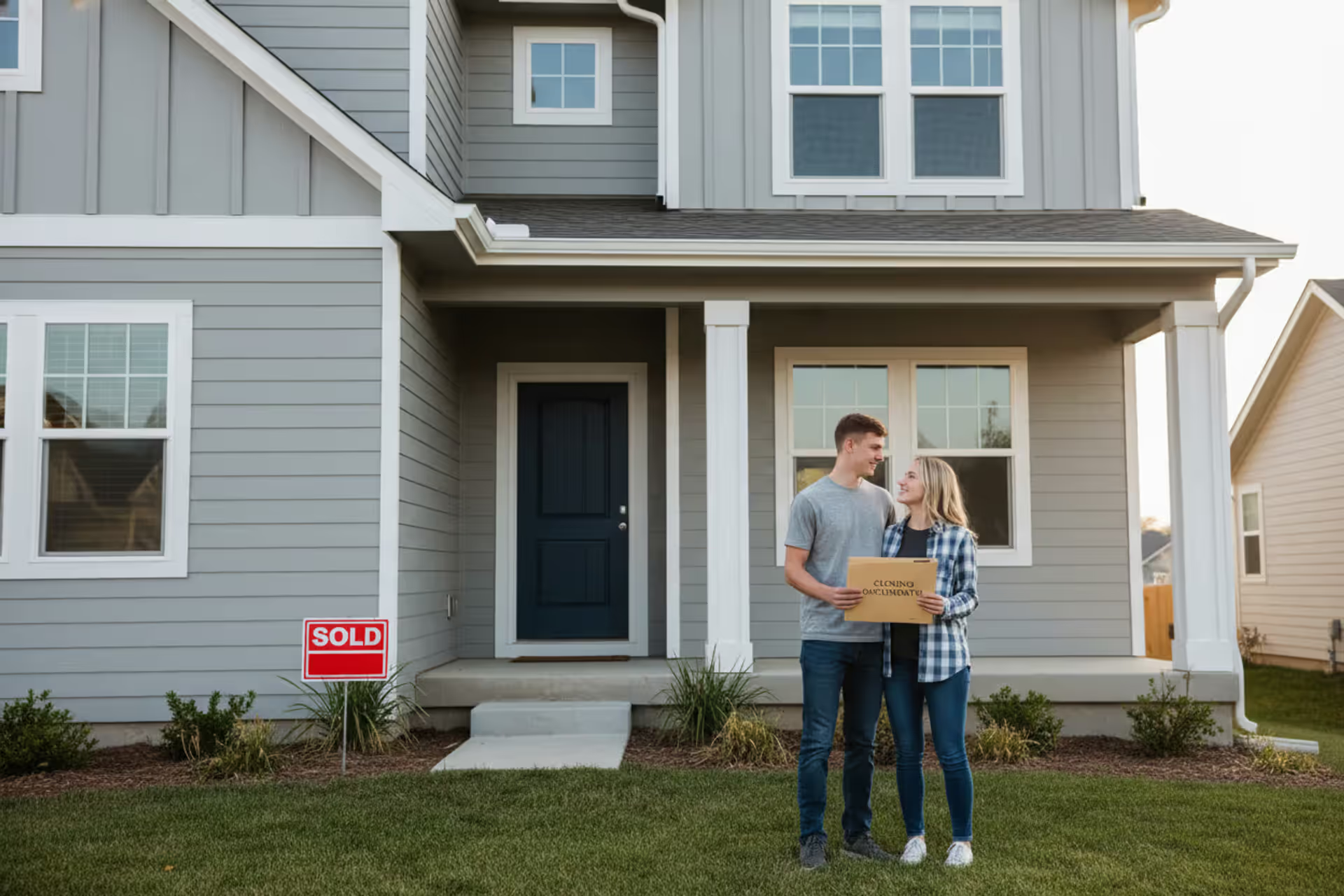
First-time home buyer reviewing mortgage documents at home
First Time Home Buyer Grant Guide

You've saved $8,000. The homes you like cost $280,000. With a 5% down payment, you need $14,000 just to get in the door—plus another $7,000 for closing costs. At your current savings rate, that's three more years of renting. Here's what most buyers don't know: government programs will hand you that money right now, and you won't pay it back if you live in the house for a few years. These programs sit unused because people assume they won't qualify or don't know where to look.
What Are First Time Home Buyer Grants?
Think of these as gift money from government agencies. You receive cash at closing—anywhere from $3,000 to $40,000 depending on the program—to cover your down payment, closing costs, or both. No monthly payments. No interest charges. The catch? You must live in the home as your primary residence for a set period, usually three to five years.
Here's how they differ from loans: Your mortgage is debt you repay every month for 15 or 30 years. These grant programs give you money that disappears from your obligation gradually. Live in your home for the required timeframe, and the entire amount vanishes. It's as if someone paid part of your down payment and asked nothing in return except that you actually live there.
Three levels of government run these initiatives. HUD coordinates federal efforts and funnels money to state agencies. Your state housing finance authority creates programs specific to local market conditions—California's programs look nothing like Nebraska's because a $400,000 home in Sacramento equals a $150,000 home in Omaha. Then cities and counties pile on their own assistance. You might grab $10,000 from your state, another $7,500 from your county, and $3,000 from a city revitalization program. Stack them correctly, and you're buying a home with $500 out of pocket.
Why do governments do this? Homeownership stabilizes neighborhoods, improves local economies, and keeps families rooted in communities. The money gets distributed directly to sellers or closing agents—you never touch it—which prevents misuse and ensures funds go toward the actual purchase.

Author: Brandon Kingswell;
Source: isomfence.com
Traditional mortgages demand you show up with 3% to 20% cash. You're buying a $300,000 house? Bring $9,000 to $60,000. Homeownership grant options for new buyers slash or eliminate that requirement entirely, though you'll still pay for inspections, appraisals, and earnest money during the transaction.
Who Qualifies for First Time Home Buyer Grants?
Income caps shut out high earners, but the limits surprise most people. Programs target households earning 80% or less of their area's median income. What does that mean in real numbers? A family of four in Indianapolis might qualify earning up to $72,000 annually. That same family in San Francisco could make $110,000 and still get approved. The limits adjust for local cost of living and family size.
Your credit score matters less than you think. Most programs accept 620 or higher. Some specialty initiatives go down to 580. A few accept 560 if you compensate with higher income stability or complete financial counseling. Sure, your score affects your mortgage interest rate—and that impacts your wallet far more over 30 years than any grant amount—but it won't necessarily disqualify you from assistance.
Here's the buyer grant eligibility overview that confuses everyone: you don't need to be buying your very first property ever. Federal standards say you qualify if you haven't owned a home in the past three years. Sold your house in 2020 and it's now 2024? You're a "first-time buyer" again. Divorced and your ex-spouse kept the house two years ago? You qualify in most programs even though you technically owned property recently. Single parents who co-owned with a former partner often get first-time status immediately.
The property must be your primary residence. Investment properties don't count. Vacation homes don't count. You're signing paperwork promising to live there, and housing agencies verify occupancy. Some programs restrict assistance to single-family homes. Others include condos, townhouses, and manufactured housing if they meet certification standards. Purchase price caps prevent you from using grant money on luxury properties—limits range from $275,000 in rural counties to $800,000 in expensive metro areas.
You must be a U.S. citizen or hold qualifying immigration status. Employment history carries less weight than consistent income. Self-employed? You'll qualify with two years of tax returns showing steady earnings.
Additional requirements pop up program by program: completing an eight-hour homebuyer education class, contributing at least 1% from your own savings, or buying in designated neighborhoods. Some programs reserve funds for teachers, healthcare workers, or public safety employees.

Author: Brandon Kingswell;
Source: isomfence.com
Types of Grants Available for First Time Buyers
Down Payment Assistance Grants
Your biggest obstacle: accumulating $15,000 to $25,000 for a down payment while simultaneously paying $1,800 monthly rent. Down payment grants eliminate this catch-22 by providing lump sums ranging from flat $5,000 awards to percentage-based assistance covering 3% to 5% of your purchase price. A few generous programs cap out at $20,000 or $25,000 regardless of how expensive your home is.
Understanding down payment grant basics starts with the forgiveness timeline. True grants require zero repayment after you satisfy occupancy terms—typically three to five years of living there. Sell after two years of a five-year requirement? You'll repay 60% of the original amount. Stay the full five years, and the obligation evaporates completely.
Programs often mandate pairing their grants with specific mortgages. You might need an FHA loan, a conventional mortgage at 97% loan-to-value, or your state's bond program. This requirement ensures the total financing package meets underwriting standards and doesn't create excessive risk.
Closing Cost Grants
Down payment covered? Great—now you need another $8,000 for closing costs. These include lender fees, title insurance, attorney charges (in states requiring lawyers), appraisal costs, inspection fees, recording fees, prepaid property taxes, and homeowners insurance. On a $280,000 purchase, closing costs typically hit $5,600 to $14,000. That's on top of your down payment.
Closing cost grants specifically target these line items. Some programs provide a flat amount—$4,000 or $6,000. Others calculate assistance as 2% to 3% of the purchase price. You submit an estimated closing disclosure, and the program approves coverage for eligible fees.
Certain programs merge down payment and closing cost assistance into one pool, letting you allocate funds wherever you need them most. Others strictly separate the two, requiring individual applications for each bucket. Ask upfront: "Does this cover down payment only, closing costs only, or can I use it for either?"
Forgivable Loan Programs

Author: Brandon Kingswell;
Source: isomfence.com
These occupy a middle ground. You receive funds at closing structured as a loan—complete with promissory note, deed of trust, and lien recorded against your property. But the debt forgives incrementally as you live there.
Standard structure: 20% annual forgiveness over five years. Borrow $15,000. After year one, you owe $12,000. After year two, $9,000. By year five, the balance hits zero and the lien releases. Sell after three years? You repay the remaining $6,000 from your sale proceeds.
These loans charge 0% interest, so the balance never grows. Most operate as "silent second mortgages" requiring no monthly payment. The loan sits quietly behind your primary mortgage until it either forgives completely or comes due when you sell.
Forgivable loans offer wider availability than grants for first time buyers. When grant funding runs dry mid-year, forgivable loan programs often continue operating since early repayments from sellers who move recirculate as assistance for new buyers.
| Type | Typical Amount | Repayment Rules | Best For | Watch Out For |
| Down Payment Grant | $5,000–$20,000 or 3–5% of purchase price | Nothing owed after 3–5 years of occupancy | Buyers with income but minimal savings | Must stay in home for full term or repay partially |
| Closing Cost Grant | $2,000–$8,000 or 2–3% of purchase price | Rarely requires repayment | Buyers who saved down payment but lack funds for fees | Often requires specific loan types |
| Forgivable Loan | $10,000–$40,000 | Forgives 20% per year over 5 years | Buyers planning to stay long-term | Creates lien on property; repay if selling early |
How to Find Grants in Your State
Start with your state housing finance agency. Every state operates one. Google "[Your State] Housing Finance Agency" and you'll land on their website. These agencies manage the largest assistance pools and maintain databases listing programs, income limits, and participating lenders. Kentucky Housing Corporation. Ohio Housing Finance Agency. Washington State Housing Finance Commission. They all follow similar naming patterns.
HUD's website hosts a searchable directory of approved housing counseling agencies. These nonprofits offer free or low-cost guidance, helping you identify programs matching your situation and income level. Since most grants require completing a HUD-approved homebuyer education course anyway, connecting with a counselor early kills two birds with one stone. Search "HUD housing counseling" plus your city name.
Don't overlook county and city housing departments. They run hyperlocal programs funded through community development block grants or local affordable housing trust funds. Your state might offer $8,000 while your city adds $6,000 for purchases in designated zip codes. These programs barely advertise—you have to call housing departments directly or ask a housing counselor who tracks them. Milwaukee has programs Madison doesn't. Brooklyn has programs Manhattan doesn't.
Employer-based assistance flies under the radar. Large hospitals, universities, and corporations in competitive hiring markets sometimes offer homebuyer grants to attract and retain employees. Teachers, police officers, firefighters, and healthcare workers often qualify for occupation-specific programs with better terms than public offerings. Ask your HR department: "Does the company offer any homeownership assistance?"
Begin this research at least six months before you're ready to buy. Some programs accept applications year-round until funds exhaust. Others open narrow enrollment windows—applications accepted only in March and September, for example. Missing a window means waiting months for the next opportunity.
Create a simple spreadsheet: program name, income limit, grant amount, required mortgage type, occupancy period, application deadline. You'll likely identify seven to twelve programs you theoretically qualify for, then narrow to three or four based on which lenders participate and which offer the best combination of grant amount and mortgage terms.
How to Apply for a First Time Home Buyer Grant
Following this first buyer grant guide starts with homebuyer education. Expect an eight-hour course covering budgeting, mortgage types, maintenance costs, and foreclosure avoidance. Classes run online or in-person. Cost: $50 to $125. Upon completion, you receive a certificate valid for one to two years depending on the program. Don't skip this—98% of grant programs require it.
Contact lenders who participate in your chosen program. Grant programs maintain approved lender lists because these companies understand the specific requirements and paperwork flow. Using a non-participating lender is pointless—they can't access grant funds even if you qualify. Interview two or three approved lenders, comparing interest rates, fees, and their experience with your specific grant program. Ask: "How many of these grants have you closed in the past six months?"
Your lender handles most logistics, but you'll gather documentation:
- Two years of tax returns and W-2 forms
- Pay stubs covering the most recent 30 days
- Bank statements (all accounts, most recent two months)
- Photo ID and Social Security card
- Your homebuyer education certificate
- Gift letters if family members are contributing
- Written explanations for any credit report issues
Pre-qualification happens first—a quick assessment based on verbal information. Pre-approval follows, involving full documentation review and credit underwriting. You need pre-approval before making offers. Sellers won't take you seriously otherwise. Grant approval must happen simultaneously with or immediately after mortgage pre-approval.

Author: Brandon Kingswell;
Source: isomfence.com
Grant applications require extra forms beyond standard mortgage paperwork: income certifications signed by your employer, primary residence affidavits, property eligibility worksheets confirming the home meets program criteria. Your lender should provide blank forms, but verify everything's complete before submission. One missing signature delays approval by weeks.
Timelines vary dramatically. Fast-moving state programs issue decisions within 10 to 15 days. Others take 30 to 60 days. A few operate on reimbursement—you bring your own funds to closing, then receive grant money 30 days later. This structure defeats the entire purpose and thankfully remains uncommon.
Reserve programs hold funds in your name once approved, guaranteeing availability when you find a home three months later. Non-reserve programs operate first-come, first-served at closing. You might win approval in February, find a home in June, and discover the program exhausted its annual funding in May.
Ask explicitly: "Does this program reserve funds or operate first-come at closing?" Non-reserve programs require faster home searches or choosing a different program with better funding stability.
Common Mistakes When Applying for Buyer Grants
Missing application windows happens constantly. Programs announce $5 million in funding available starting January 15th. Buyers assume money will last all year. By March 22nd, funds are gone. Set phone reminders for application opening dates and submit paperwork within the first week. Popular programs exhaust funding in 30 to 90 days.
Failing to compare programs costs real money. You qualify for a state program offering $7,500 and a county program providing $13,000. You apply for the first one you find and leave $5,500 on the table. Spend one weekend researching every program you're eligible for before committing to any single option.
Misreading repayment terms creates disasters. A buyer accepts "grant assistance" without reading the 12-page program guidelines, then discovers it's actually a deferred-payment loan due in full upon sale—not a forgivable loan. Always ask your lender: "Under what exact circumstances do I owe this money back? What happens if I sell after two years? After four years?" Get written clarification.
Failing to meet occupancy requirements triggers repayment. The grant requires five years of occupancy. A job transfer forces relocation after 30 months. You owe prorated repayment—50% of the original amount. Some programs grant hardship exceptions for involuntary job loss, military deployment, or divorce. Document your situation thoroughly and request a waiver before listing your home for sale.
Focusing only on grant size while ignoring interest rates backfires. Program A offers $16,000 but requires a mortgage at 6.75% interest. Program B provides $9,000 with a 5.875% rate. Over 30 years, that lower rate saves $52,000 in interest—far exceeding the smaller grant amount. Run complete payment calculations including both grant amounts and total interest paid before deciding.
House hunting before approval wastes everyone's time. You fall in love with a home, make an offer, enter contract, then discover you don't qualify for the grant program you assumed would work. Sellers reject your modified offer, and the home goes to a backup buyer. Get full mortgage and grant approval before touring properties seriously.
Common Mistakes When Applying for Buyer Grants
Missing application windows happens constantly. Programs announce $5 million in funding available starting January 15th. Buyers assume money will last all year. By March 22nd, funds are gone. Set phone reminders for application opening dates and submit paperwork within the first week. Popular programs exhaust funding in 30 to 90 days.
Failing to compare programs costs real money. You qualify for a state program offering $7,500 and a county program providing $13,000. You apply for the first one you find and leave $5,500 on the table. Spend one weekend researching every program you're eligible for before committing to any single option.
Misreading repayment terms creates disasters. A buyer accepts "grant assistance" without reading the 12-page program guidelines, then discovers it's actually a deferred-payment loan due in full upon sale—not a forgivable loan. Always ask your lender: "Under what exact circumstances do I owe this money back? What happens if I sell after two years? After four years?" Get written clarification.
Failing to meet occupancy requirements triggers repayment. The grant requires five years of occupancy. A job transfer forces relocation after 30 months. You owe prorated repayment—50% of the original amount. Some programs grant hardship exceptions for involuntary job loss, military deployment, or divorce. Document your situation thoroughly and request a waiver before listing your home for sale.
Focusing only on grant size while ignoring interest rates backfires. Program A offers $16,000 but requires a mortgage at 6.75% interest. Program B provides $9,000 with a 5.875% rate. Over 30 years, that lower rate saves $52,000 in interest—far exceeding the smaller grant amount. Run complete payment calculations including both grant amounts and total interest paid before deciding.
House hunting before approval wastes everyone's time. You fall in love with a home, make an offer, enter contract, then discover you don't qualify for the grant program you assumed would work. Sellers reject your modified offer, and the home goes to a backup buyer. Get full mortgage and grant approval before touring properties seriously.
We counsel families earning $65,000 annually who've been renting for eight years, paying $1,900 monthly, who could buy a home next month with grant assistance.These programs exist specifically for working families who simply need help with upfront costs. The hardest part is convincing people they actually qualify
— Jennifer Martinez
Frequently Asked Questions About First Time Home Buyer Grants
Over $300 million in grant funding flows through state and local programs annually, yet thousands of qualified buyers never apply. They assume they won't qualify. They think the process is too complicated. They believe grants only help people earning minimum wage. All wrong.
Begin by completing a homebuyer education course before you're ready to buy. The knowledge helps you evaluate programs critically and avoid expensive mistakes. Connect with a HUD-approved housing counseling agency—their services are free or cost under $100, and their expertise saves thousands.
Research systematically. Compare income limits, grant amounts, and occupancy requirements across multiple programs. The best option might be the sixth one you discover, not the first. Work only with lenders approved for your chosen programs. Get full pre-approval before making offers on homes.
Remember: grants solve the savings problem, not the affordability problem. A grant covering your down payment helps nobody if the monthly mortgage payment exceeds your budget by $400. Calculate complete payments including principal, interest, taxes, insurance, and HOA fees before committing to a purchase price.
The path to homeownership with grant assistance demands patience, systematic research, and attention to detail. For buyers willing to invest the effort, these programs deliver exactly what they promise: keys to your own home, without the years of additional saving that would otherwise be required.
Related Stories

Read more
Read more




The content on this website is provided for general informational and educational purposes only. It is intended to explain concepts related to home loans, mortgage rates, home equity loans, and the home buying process.
All information, including articles, guides, and explanations, is provided for general educational purposes only. Mortgage terms, interest rates, eligibility requirements, and lending conditions may vary depending on individual financial situations, lenders, and regional regulations.
This website does not provide financial, legal, or mortgage advice, and the information presented should not be considered a substitute for consultation with qualified financial professionals, lenders, or advisors.
The website and its authors are not responsible for any errors or omissions, or for any decisions made based on the information provided on this website.