

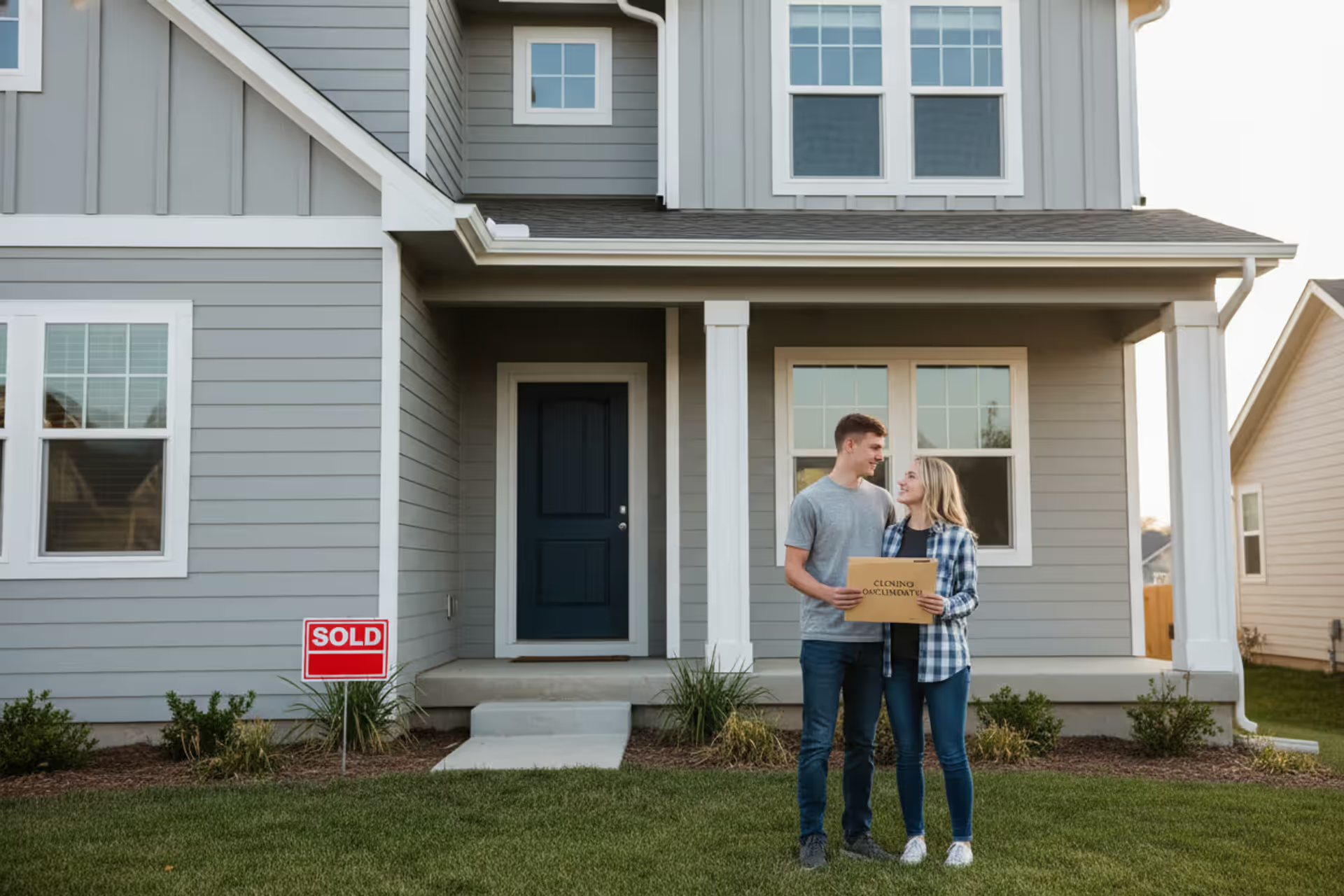
First-time home buyer reviewing mortgage assistance options at home
First Time Home Buyer Programs Guide

That moment when you calculate how long it'll take to save a 20% down payment? For most people earning median wages, it's somewhere between "depressing" and "maybe when I'm 45." Here's what changes that math: assistance programs that can hand you $10,000, $15,000, or more toward your purchase—and you probably qualify even if you think you earn too much.
I'm talking about actual programs putting actual money toward your down payment and closing costs. Not theoretical future tax breaks. Not vague advice about "saving more." Real financial assistance that works whether you're a teacher earning $48,000 or a dual-income couple pulling in $95,000. Location matters more than you'd guess, and timing matters even more, but if you're willing to do some research and paperwork, these programs can cut years off your timeline.
What Are First Time Home Buyer Programs?
First time home buyer programs give you money or favorable loan terms when you're buying a home. The "first time" label is actually misleading—you might qualify even if you owned a condo back in 2015. The standard definition: you haven't held ownership in a primary residence during the previous three years. Sold your house in 2021? You're eligible now in 2024.
Beyond the three-year rule, special categories exist. Got divorced and your ex kept the house? Several programs classify you as a first-timer regardless of how recently you were on that deed. Military veterans sometimes qualify even if they currently own property in another state. Parents who co-owned property with an adult child but never held sole ownership may qualify under "displaced homemaker" provisions.
Four distinct sources fund these programs, and you can often combine them:
Federal backing supports FHA loans (available through any approved lender), VA loans (exclusively for military service members and veterans), and USDA loans (restricted to eligible rural and suburban zones). The government doesn't loan you money directly—they guarantee your loan so banks will approve you with less-than-perfect credit and minimal down payment.
State housing finance agencies exist in all 50 states, operating independently with their own budgets and rules. Michigan's program looks nothing like Arizona's. These agencies issue bonds to raise money, then use proceeds to fund assistance grants and below-market-rate mortgages. They're quasi-governmental—not quite private banks, not quite state welfare departments.
City and county initiatives target local priorities. Your county might offer $20,000 forgivable loans but only for homes in three specific ZIP codes they're trying to revitalize. A city program might provide $8,000 grants exclusively to police officers, firefighters, and teachers buying within city limits.
Bank-sponsored options come from individual lenders wanting to serve communities or meet regulatory requirements. These tend to be smaller—maybe $1,500 toward closing costs—but they stack on top of other programs and sometimes come with relationship perks like waived origination fees.
Understanding the ownership lookback period matters financially. If you're two years out from a sale, waiting 12 more months before buying could unlock $15,000 in assistance. If you're four years out, you're golden—start applying tomorrow.

Author: Olivia Thornton;
Source: isomfence.com
Types of Programs for First Time Buyers
FHA Loans and Low Down Payment Options
An FHA-insured loan asks for 3.5% down payment and works with credit scores down to 580 (or 500 if you somehow scrape together 10% down). The math on a $275,000 purchase: you need $9,625 up front versus $55,000 for the conventional 20% down payment advice you'll hear from your parents.
Here's the catch everyone discovers later: mortgage insurance premiums stick around forever when you put down less than 10%. We're talking roughly $220–$270 added to your monthly payment on that $275,000 loan. Unlike conventional loan PMI that drops off eventually, FHA's MIP stays until you refinance into a different loan type. Factor this into your long-term costs.
The power play? Layer FHA with down payment assistance. Maybe your state gives you a $10,000 grant covering your 3.5% down payment plus some closing costs. Now you're buying that $275,000 home with perhaps $3,000 out of pocket instead of $9,625. Stack smartly and some buyers get into homes with under $2,000 total cash outlay.
State and Local Down Payment Assistance
Every single state runs homeownership programs for new buyers through their housing finance agency, though generosity varies wildly. You'll encounter three main assistance structures:
Outright grants disappear from your obligation entirely. California's CalHFA might give you $10,000, you use it for down payment and closing costs, and you never owe it back. These competitive programs favor lowest-income applicants.
Forgivable second mortgages function as grants with a patience requirement. Picture this: you get $18,000 as a silent second loan at zero interest. Live there eight years, and the entire balance forgives—poof, gone. Sell after five years? You'll owe back a prorated portion, maybe $6,750 of the original amount.
Deferred payment junior loans require zero monthly payment but must be repaid when you sell, refinance your first mortgage, or convert the property to a rental. Borrow $22,000 today, make no payments while you live there, then repay that $22,000 (sometimes with modest interest, sometimes without) from your sale proceeds in 2035.
Matched savings accounts reward disciplined savers. Deposit $75 monthly into a supervised IDA account for 18 months ($1,350 total), and the program contributes $2,700 or $4,050 as a match—suddenly you have $4,050 to $5,400 for your purchase. Time-consuming but powerful for people who can budget consistently.
Mortgage Credit Certificates work differently—they're not cash assistance but rather a federal tax credit worth 20%–50% of your annual mortgage interest paid. You pay $14,000 in mortgage interest this year, your MCC gives you a 35% rate, and you receive a $4,900 tax credit (reducing your actual tax bill dollar-for-dollar, not just your taxable income). This frees up cash flow monthly and helps you qualify for a larger loan amount.
Real example: Pennsylvania's PHFA provides up to $15,000 assistance combined with interest rates 0.5% below market. Texas has allocated $51 million to its "Homes for Texas Heroes" program serving teachers, healthcare workers, and first responders. Ohio offers $7,500 grants in targeted counties where median home prices remain under $180,000.
Programs close when funding exhausts. Arizona's assistance might launch January 15th and close February 28th because 1,800 applicants grabbed all available funds. Check monthly for reopening dates.

Author: Olivia Thornton;
Source: isomfence.com
USDA and VA Loan Programs
USDA loans demand zero down payment for properties located in USDA-eligible areas—and "rural" surprises people. Plenty of suburbs 30 minutes from major cities qualify. You can verify any specific address through the USDA's property eligibility map online before you even tour a home.
Income caps apply: household income cannot exceed 115% of your area's median. That might mean $103,000 in one county and $88,000 in another, adjusting for local cost of living. USDA charges a 1% upfront guarantee fee (added to your loan) plus 0.35% annually in ongoing fees—substantially less than FHA's insurance costs.
VA loans, exclusively for veterans and active military, also require nothing down and charge no monthly mortgage insurance whatsoever. You'll pay a funding fee between 1.4% and 3.6% depending on your service category and down payment amount, but disabled veterans with VA compensation pay zero funding fee. The benefit here is massive—a veteran could purchase a $340,000 home, finance 100% of it, and pay only closing costs (often negotiated onto the seller or covered through lender credits).
Both programs finance the entire purchase price. That's not 97% or 98%. That's 100% financing. If you meet the eligibility requirements, you're looking at homeownership with minimal cash outlay.

Author: Olivia Thornton;
Source: isomfence.com
Conventional Loan Programs for New Buyers
Conventional mortgages—not government-backed—offer several first-timer-friendly options:
Conventional 97 loans require 3% down and allow non-occupant co-borrower income. Translation: your parents can co-sign and help you qualify even though they won't live in the home. Their income strengthens your application, but they take on the legal obligation too.
Fannie Mae's HomeReady and Freddie Mac's Home Possible both accept 3% down and count income from household members not on the mortgage. Your partner earns $35,000 but doesn't want their name on the loan? Their income can still help you qualify for a larger amount under these programs' rules.
The advantage over FHA? Private mortgage insurance on conventional loans cancels automatically once you reach 22% equity (or you can request cancellation at 20%). On a $265,000 home, PMI might cost $135 monthly and disappear after five years of payments plus appreciation. With FHA, you'd pay that insurance forever unless you refinance.
Income limits restrict HomeReady and Home Possible—typically 80% of area median income, though this increases to 100% in designated high-need neighborhoods. A single buyer in a medium-cost market might face a $68,000 income cap, while a couple in Seattle could earn $115,000 and still qualify due to their area's elevated median income and underserved-area designation.
How First Buyer Assistance Programs Work

Author: Olivia Thornton;
Source: isomfence.com
Down payment help arrives in several formats with different repayment expectations:
Grants = free money, zero repayment obligation. Receive $12,000, use it however the program allows (usually down payment and closing costs), owe nothing back ever. Rare and competitive, these typically serve lowest-income brackets or specific professions like teaching.
Forgivable loans = conditional grants. You get $16,000 as a second mortgage charging no interest. Remain in the home for the required period (commonly five to ten years), and the debt evaporates completely. Leave earlier? You repay a percentage. Stay six years of a required eight, and you might owe $4,000 of the original $16,000 back.
Deferred-payment loans require no monthly payment but full repayment when you sell, refinance, or stop occupying the property. Borrow $25,000 now, make zero payments for a decade, sell in 2034, and repay $25,000 from your proceeds. Some accrue interest (typically low rates like 2%–3%), others remain static at the original amount.
Matched savings programs (Individual Development Accounts) match your regular deposits. Save $40 every two weeks for two years ($2,080 saved), and the program contributes $4,160 or $6,240 depending on their match rate—you end up with $6,240 to $8,320 total. Requires discipline and advance planning since you can't save the money in three months.
Mortgage Credit Certificates aren't upfront cash but tax credits worth 20%–50% of your annual mortgage interest. Pay $11,000 in mortgage interest next year, hold a 30% MCC, and you receive a $3,300 tax credit. This isn't a deduction reducing taxable income—it directly reduces your tax bill. The increased take-home pay helps you qualify for more house, and you benefit annually as long as you hold the mortgage.
Stacking multiple programs is explicitly allowed in many cases. You might use: VA loan (zero down) + state grant ($8,000 for closing costs) + MCC (tax credits). Or: FHA loan (3.5% down) + county forgivable loan (covers down payment) + city grant ($3,000 for closing costs). Confirm compatibility with your lender since some state programs don't stack with others from the same agency.
The biggest mistake I see is buyers choosing the first program they hear about without comparing alternatives. A buyer might grab a $5,000 grant with strict income limits when a different program would have given them $12,000 with more flexible terms. Spend two weeks researching before you commit—it's worth thousands of dollars
— Jennifer Martinez
Eligibility Requirements for Homeownership Programs
Looking through any first purchase program guide reveals these recurring requirements:
Income ceilings are the most frequent barrier. Programs cap eligibility at 80%, 100%, or 120% of area median income. In a county with $93,000 median household income, an 80% AMI program stops you at $74,400 annually. High-cost regions push these limits higher—that same 80% AMI rule might allow $118,000 in the Bay Area.
Income calculations include all adult household members (18+), even those not applying for the loan. Your 22-year-old earning $28,000 while living with you gets added to your $72,000, potentially pushing you past limits. Programs vary—some exclude full-time students, others count only borrowers' income. Read specific program language carefully.
Credit score floors range dramatically. FHA accepts 580, but state programs often want 640 or better. A handful of local initiatives work with 550-580 scores if you complete extensive counseling and demonstrate compensating factors. Hit 620 and you'll qualify for most programs; below that, options shrink considerably.
What caused your score to drop matters more than the number itself. A 635 score from high credit utilization looks better than a 650 score with a foreclosure from two years ago. Late housing payments (rent or mortgage) hurt worse than medical collections.
Property type restrictions eliminate certain homes from eligibility. Most programs approve single-family houses, townhomes, and condos meeting specific standards. Investment properties, vacation homes, and major fixer-uppers usually don't qualify (exception: FHA 203(k) rehab loans allow you to finance repairs into your mortgage).
Purchase price caps apply in numerous programs. Your state might limit assistance to homes under $425,000 in expensive counties and $290,000 in affordable ones. These limits adjust annually based on local market conditions and can vary by county within the same state.
Occupancy obligations require you to actually live in the home as your primary residence—typically one year minimum. Convert it to a rental after eight months, and you'll repay all assistance plus penalties. Forgivable loan programs extend this to 5–15 years if you want full forgiveness.
Homebuyer education certificates are mandatory for virtually all programs for first time buyers. These courses run 6–8 hours (available online or in-person) covering mortgage types, budgeting, maintenance, and foreclosure prevention. Tedious? Absolutely. Required? Yes. Useful? Actually yes—graduates make fewer costly mistakes. Your certificate stays valid 12–24 months, so complete this before you begin seriously house hunting.

Author: Olivia Thornton;
Source: isomfence.com
How to Find and Apply for a First Purchase Program
Step 1: Locate your state housing finance agency website. Search "[Your State] housing finance agency first time buyer" to find your state's official HFA site. Review available programs, noting income maximums, assistance amounts, and current funding status (some close when money runs out). Bookmark three promising programs matching your situation.
Step 2: Search city and county programs. Try "[Your City] down payment assistance" and "[Your County] home buyer program." Smaller local programs face less competition and sometimes bend rules more than state agencies. A firefighter in Columbus might discover both state and city options, potentially combining them for $25,000+ total assistance.
Step 3: Call participating lenders. State programs work exclusively through approved lenders who understand the specific paperwork and timelines. Phone 4–5 lenders from your HFA's approved list, asking about their experience with your target programs. Some lenders process these applications weekly; others do two per year and will fumble yours.
Step 4: Get pre-qualified first. Before paying for homebuyer education, verify you meet baseline requirements. A lender reviews your income, credit, and debt ratios to project what you'll qualify for. This prevents wasting time on programs you can't access anyway.
Step 5: Complete homebuyer education immediately. Register for a HUD-approved course through your state HFA, local nonprofit, or online providers like Framework Homeownership or eHome America. Cost ranges from free to $125. Plan for 6–8 hours, receive your certificate instantly upon finishing.
Step 6: Assemble required documentation. Expect to provide two years of tax returns, 30 days of pay stubs, two months of bank statements, and documentation of all other income. Assistance programs add requirements like written confirmation you haven't owned property in three years and your education certificate.

Author: Olivia Thornton;
Source: isomfence.com
Step 7: Submit applications. Your lender handles most paperwork, filing your mortgage application and assistance application together. State programs often require a separate application through their online portal. Processing takes 30–60 days typically, longer during spring when applications surge.
Step 8: Shop with approved financing. Once approved, you'll know your maximum purchase price and assistance amount. Your pre-approval letter proves to sellers you have financing arranged. Begin house-hunting within your budget, remembering any property price caps your assistance program imposes.
Common Mistakes When Using Buyer Assistance Options
Missing application windows eliminates your opportunity entirely. State programs typically operate on first-come, first-served allocation within annual funding cycles. Applications might open January 3rd, funding might vanish by March 20th. Set calendar reminders for when your chosen program launches and apply within week one if funding is limited.
Failing to compare programs wastes thousands. Your state might simultaneously offer: a $6,500 grant with harsh income limits, a $13,000 forgivable loan with moderate limits, and a $17,000 deferred-payment loan with lenient limits. If you qualify for all three, the $17,000 option obviously wins—but people grab the first one their realtor mentioned.
Delaying homebuyer education until you find a house creates closing delays. You discover your perfect home, make an offer, then realize you need that education certificate to unlock your assistance. Courses are full for three weeks, or you can't finish the online version fast enough, and your closing gets pushed (or the seller accepts someone else's offer). Complete education before you tour properties.
Ignoring recapture tax on MCC and certain federal programs creates surprise bills at sale time. Recapture tax requires repaying some tax credit benefits if you sell within nine years AND your income increased significantly AND you made profit on the sale. The formula is Byzantine, but you might owe $1,800–$5,500 when you sell. Not a deal-breaker, but factor this into your math if you plan to move within five years.
Selecting the wrong property kills your assistance after falling in love with a home. You find an amazing condo, make an offer, then learn your assistance program excludes condos—only detached single-family homes qualify. Or the house needs a $40,000 roof replacement, but your program requires move-in-ready properties. Understand property restrictions before scheduling tours.
Misreading forgivable loan terms leads to unexpected repayment. A loan forgives 20% per year over five years. You assume selling after three years means you owe 40%, but the actual program requires full repayment plus 3% interest if you sell before the five-year mark. Read the promissory note completely or ask a housing counselor to explain the precise terms in plain language.
Comparison of Major First-Time Buyer Programs
| Program Type | Down Payment Required | Income Caps | Minimum Credit Score | Works Best For |
| FHA Loan | 3.5% of purchase price | None (debt-to-income ratios apply) | 580 (or 500 with 10% down) | Buyers with modest savings and credit in the 580–680 range |
| State DPA | Varies (often covers 3–5% of price) | Usually 80–120% AMI by location | Commonly 620–660 | Buyers needing down payment help who fall under income thresholds |
| USDA Loan | Zero | 115% AMI maximum | 640 preferred by most lenders | Suburban/rural buyers with moderate income |
| VA Loan | Zero | None whatsoever | None required (lenders typically want 620+) | Veterans, active military, and eligible surviving spouses |
| Conventional 97 | 3% of purchase price | None | 620 | Buyers with solid credit wanting future PMI cancellation |
| HomeReady/Home Possible | 3% of purchase price | 80% AMI (100% in underserved locations) | 620 | Lower-income buyers with good credit and consistent employment |
Frequently Asked Questions
First time home buyer programs transform homeownership from fantasy to reality for roughly 300,000–400,000 buyers annually. The path involves paperwork, patience, and navigating income documentation plus property restrictions—but the financial reward justifies the hassle when you're getting $12,000, $18,000, or more toward your purchase.
Begin by identifying which programs match your specific situation. State assistance works for most buyers, while VA and USDA programs serve particular groups exceptionally well. Compare at least three options before committing, and partner with a lender who processes these applications regularly rather than learning on your file.
Complete homebuyer education early (don't wait), gather financial documents methodically, and apply the moment programs open for the year if they operate on limited funding. The buyers who succeed with assistance programs are those who plan ahead, stay organized, and persist when programs seem complicated or funding temporarily runs dry.
Homeownership programs for new buyers exist because communities benefit when residents can afford to purchase homes. These resources were designed for people exactly like you—and using them strategically can eliminate years of saving while putting thousands of dollars back in your pocket that would otherwise go toward down payments and closing costs.
Related Stories

Read more
Read more


The content on this website is provided for general informational and educational purposes only. It is intended to explain concepts related to home loans, mortgage rates, home equity loans, and the home buying process.
All information, including articles, guides, and explanations, is provided for general educational purposes only. Mortgage terms, interest rates, eligibility requirements, and lending conditions may vary depending on individual financial situations, lenders, and regional regulations.
This website does not provide financial, legal, or mortgage advice, and the information presented should not be considered a substitute for consultation with qualified financial professionals, lenders, or advisors.
The website and its authors are not responsible for any errors or omissions, or for any decisions made based on the information provided on this website.